
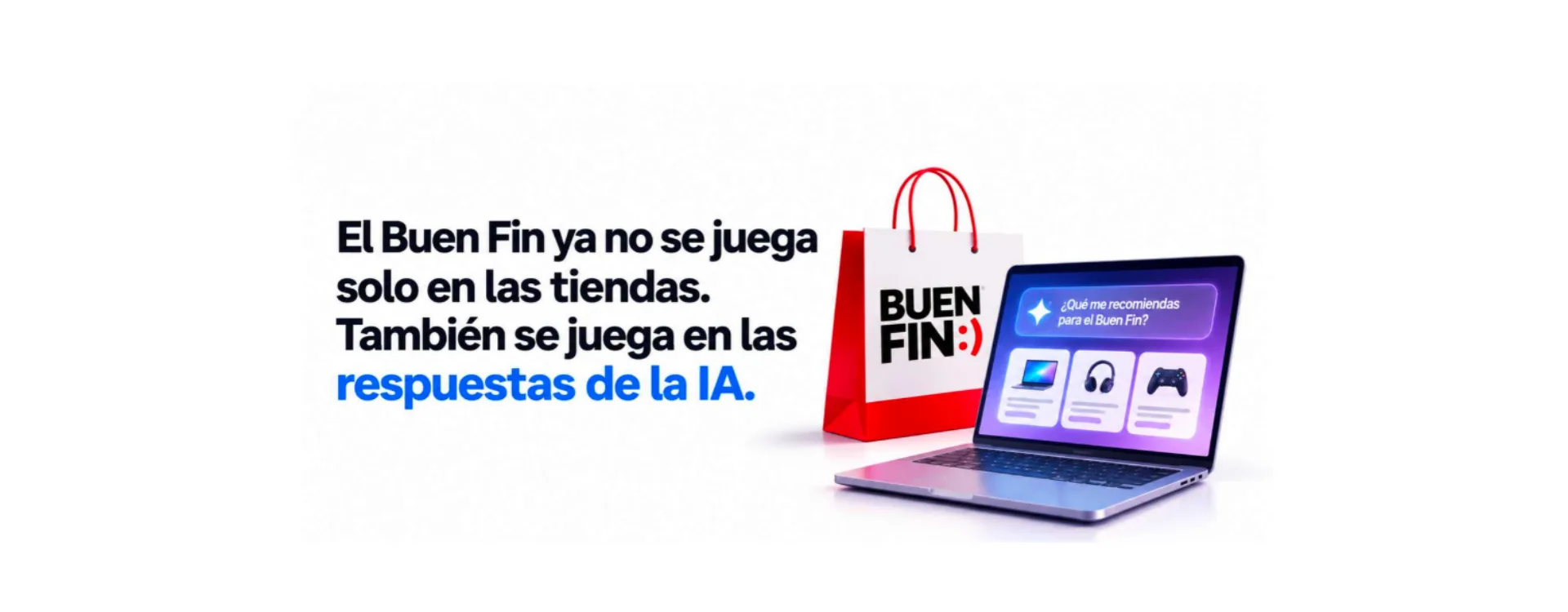
Algorithm visibility, recommendation fragmentation, and third-party relevance: The 'AI Shelf' map in El Buen Fin
The search for deals and products for El Buen Fin migrated from traditional search engines to Artificial Intelligence-generated responses. The study AI Shelf Report | Buen Fin 2026 Edition, conducted by the analytics firm TrendValue in collaboration with the Asociación de Internet MX, Digital Venture, Ntp Media, Audacia Comunicación, and Pragmatyka, analyzed how large language models (LLMs) build their recommendations across five key consumer categories.
Measurement methodology in AI engines
The research evaluated the behavior of virtual assistants during the pre-promotional season stage:
- Scope of the analysis: 40 strategic prompts were run across 8 Artificial Intelligence engines (ChatGPT, Gemini, Claude, Copilot, Grok, DeepSeek, AI Mode, and AI Overviews) over 4 days of monitoring (from October 17 to 20, 2026).
- Consumer categories evaluated: The report analyzed brand presence and recommendations in the categories of Laptops, Screens/TVs, Facial Care, Sneakers, and Hotels (Travel).
Key findings by category: Presence vs. Choice
The report showed that high visibility in AI results does not automatically translate into becoming the recommended option:
- Screens/TVs (“Appearing is not winning”): Although Samsung leads overall presence (Share of Shelf) with 24.4% of mentions, followed by TCL (23.4%), LG (20.8%), Hisense (19.9%), and Sony (8.8%), the choice shifts depending on query intent. In price-focused searches, Hisense dominates conversion with a 41% Pick Rate. In contrast, in quality queries, LG converts better, reaching a 35% choice rate compared to Samsung, which, despite registering 68% presence, only achieves a 19% choice rate.
- Facial Care (“Dynamic recommendation”): No single brand dominates all AI engines. La Roche-Posay leads presence in 4 engines (ChatGPT, AI Mode, Copilot, and Grok), CeraVe leads in 3 engines (Gemini, AI Overviews, and DeepSeek), and Neutrogena leads in 1 (Claude). When searching for the lowest-priced option, CeraVe positioned itself as the most chosen brand with 43.8% of mentions.
- Sneakers (“Need reconfigures the rival”): In response to specific queries about El Buen Fin promotions, Nike leads the shelf with 92% presence, followed by Adidas (88%), New Balance (62%), Puma (46%), and Skechers (42%). However, when filtering by lowest price, Adidas moves to first place with 71%, while for durability and high performance, Nike (73%) and Adidas (68%) capture consumer preference.
- Laptops (“Distributed authority”): Out of 1,872 citations analyzed across 490 domains, 92.9% come from third-party sources (such as retailers with 33.4%, tech media with 24.2%, communities with 15.5%, and comparison sites with 7.2%). Official manufacturer websites represent only 7.1% of citations, demonstrating that 9 out of 10 sources feeding the AI are not directly controlled by the brand.
- Hotels/Travel (“Advertising as an alternative route”): 206 hotels were identified in a highly fragmented shelf where the top 5 accounts for less than 20% of visibility (17.3%). When explicitly including the mention of "El Buen Fin", 58.9% of the recommended hotels were new players that did not appear in general searches. Likewise, the presence of sponsored ads (Paid) within AI chats allowed properties without organic presence to appear in the responses.
From the editorial perspective of next+, the findings of the AI Shelf Report confirm that traditional web positioning strategies (SEO) are insufficient to compete in the era of AI assistants. Because 92.9% of AI citations come from third-party media, retailers, and communities, a brand's visibility depends directly on its distributed reputation and the content generated across the entire digital ecosystem. For marketing directors, e-commerce leaders, and brand strategists, winning the Artificial Intelligence recommendation during seasons such as El Buen Fin demands shifting from keyword optimization to active management of the AI Shelf, tailoring product presence to the consumer's different shopping moments and intents.