
Spending on Artificial Intelligence for 2026 is estimated at $1 trillion dollars, approximately 1% of the global economy, according to Samara Hammoud, International Economist and FX Strategist at CBA (Commonwealth Bank of Australia, 2026), and even higher figures when considering companies that supply raw materials and other services within the supply chain. Additionally, IMF research shows that at least 40% of jobs will be affected by Artificial Intelligence according to recent statements made by Kristalina Georgieva, Managing Director of the IMF during the opening session of the IMF and World Bank Annual Meetings held in Bangkok, Thailand from October 12 to 18, 2026 (International Monetary Fund [IMF], 2026). There is no doubt that we are experiencing a moment of profound economic, social, and cultural transformation globally with AI at the center of it all.
Who is developing Artificial Intelligence?
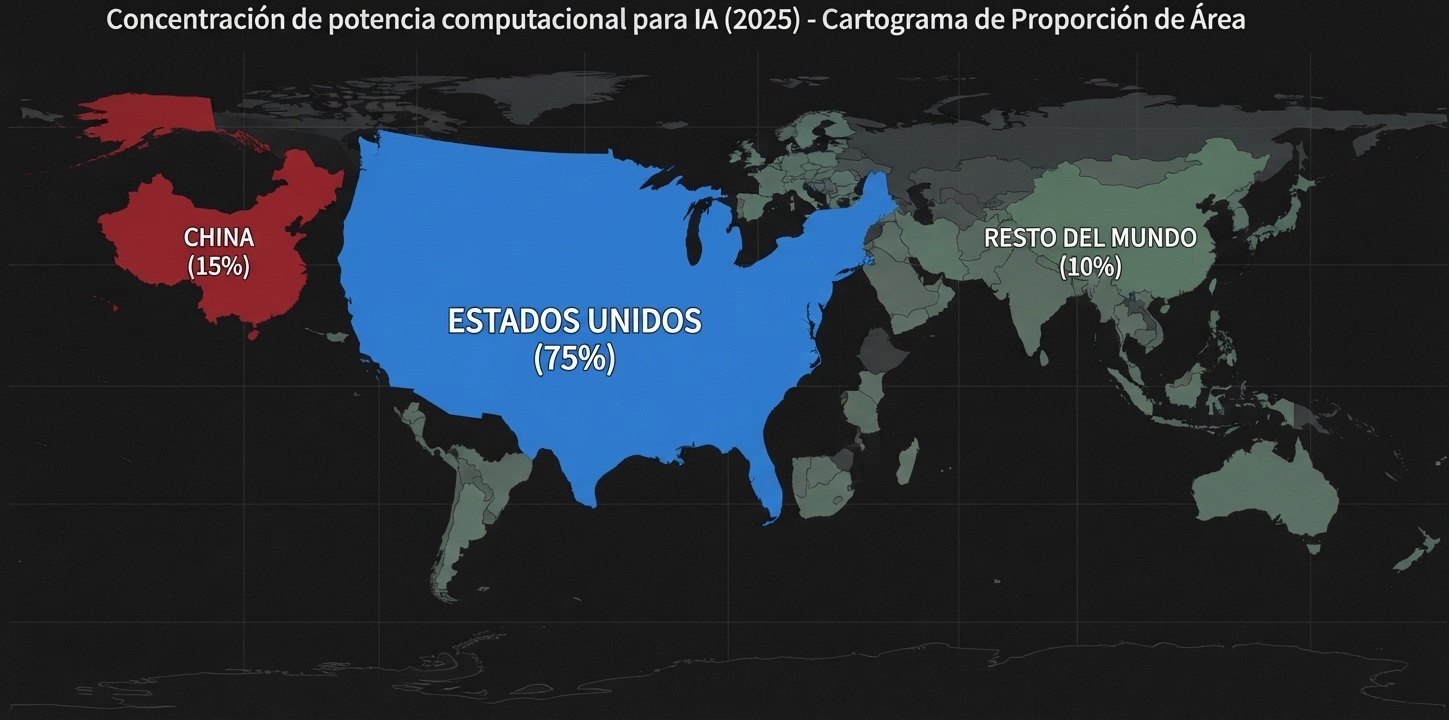
According to the preliminary report of the UN's International Scientific Panel on Artificial Intelligence (2026), a document that compiles the first scientific, global, and independent assessment to analyze the capabilities, opportunities, risks, and implications of Artificial Intelligence presented in July of this year, the leading countries in technological development where the majority of hardware, private capital investment, and intellectual power of AI models are concentrated are as follows. The leading country is undoubtedly the United States with 75% of the concentration, followed by China with 15%, and the remaining 193 countries represent only 10% of the computational power concentration. The document does not make this differentiation, but private capital is the one that monopolizes its development, as according to the OECD, 61% of global venture capital is directed to Artificial Intelligence startups (Organisation for Economic Co-operation and Development [OECD], 2026).
Who is using AI the most?
In her talk "Why are Western people wrong about the internet use of the Global South?" (Diggit Magazine, year), Dr. Payal Arora, a Digital Anthropologist who has been analyzing internet use in the most marginalized communities of the world for over a decade, asserts that the majority of data generated on the internet currently comes from the Global South, pointing out interesting disparities regarding the West. For example, users in China use the internet twice as much as users in the United States, or that in specific regions such as Sub-Saharan Africa, men use the internet up to 40% more than women due to factors such as wage gaps, cultural norms, and even personal choice.
And why is this important for the market, particularly the Tech Industry? Because unless decision-makers begin to understand how the Global South works and what people truly need, it will not be viable to offer them added value that competes with the informal economies in which they currently participate. From this privileged perspective, the goal is to offer technology as a resource to move forward in communities where the system and institutions have failed, while what people seek is actually to have their humanity recognized.
The question that Dr. Arora answers is how is it possible (in Western moral panic) that these people spend a high percentage of their scarce income on internet entertainment? The answer is simple:
Internet is the only pleasure economy that exists in some spaces and pleasure is a form of survival. And here is also the answer for the development of AI in Latin America.
References:
Commonwealth Bank of Australia. (2026, May 22). AI investment surge set to lift global economic growth and reshape trade.https://www.commbank.com.au/articles/newsroom/2026/05/ai-investment-to-lift-global-growth.html
International Monetary Fund. (2026, October 13). IMF and World Bank 2026 Annual Meetings in Bangkok. IMF Media Center.https://mediacenter.imf.org/news/imf-and-world-bank-2026-annual-meetings-in-bangkok/s/fe1b9b47-34de-4dbb-90fb-cd52f63d9026
Independent International Scientific Panel on Artificial Intelligence. (2026). Preliminary report of the Independent International Scientific Panel on Artificial Intelligence: Empirical assessment of the opportunities, risks, and implications of artificial intelligence. United Nations.https://www.un.org/independent-international-scientific-panel-ai/sites/default/files/2026-07/es_Preliminary%20Report.pdf
Organisation for Economic Co-operation and Development. (2026). Venture capital investments in artificial intelligence through 2025 (OECD Policy Briefs). OECD Publishing.https://doi.org/10.1787/a13752f5-en
Diggit Magazine. (2025, November 24). The Keynote: ‘Lessons from the Global South on Designing Inclusive Tech’ by Payal Arora [Video]. YouTube.https://www.youtube.com/watch?v=-kvJMzTU8uk