
Over the last decade, digital transformation has allowed thousands of entrepreneurs in Latin America to expand their selling methods. First came the digital point of sale; then e-commerce; later marketplaces and social networks. Each new channel represented an opportunity to reach more customers and expand the business.
However, today the challenge is no longer just about selling in more places. The next stage of digital transformation is occurring within companies: integrating operations so that sales, inventory, payments, invoicing, and customer service function as one cohesive information system.
In other words, commerce is no longer measured by the number of available channels, and it begins to be differentiated by companies' ability to make data-driven decisions.
The OECD identifies that digital commerce is evolving towards business models where e-commerce, digital payments, omnichannel strategies, new technologies, and data utilization converge. For SMEs, this change means that digital transformation is no longer just about selling through more channels, but about integrating information from their entire operation to make better decisions.
Information begins where intuition ends
For decades, small businesses grew thanks to the experience of their founders. Knowing the customer, understanding market behavior, and reacting quickly to changes allowed for the building of thousands of successful businesses in the region. This experience continues to be one of the most important assets of any entrepreneur. What has changed is the ability to complement it with information that simply did not exist before.
Today, every sale, every inventory movement, and every interaction with a customer generates data that helps identify consumption patterns, understand which products have higher turnover, anticipate supply needs, and respond more quickly to demand. The difference is that digitization is no longer just about recording transactions. Its true value emerges when that information aids in making better decisions. Data does not replace the entrepreneur's knowledge; it strengthens it.
When a business has organized information, it can reduce errors, optimize resources, respond with greater agility, and grow in a more orderly manner.
In this context, the OECD itself warns that digitization is redefining competition and positioning the strategic utilization of data as one of the key differentiators for companies in the coming years.
For Mexican SMEs, this transition represents a particularly relevant opportunity. Many have already started their digitization process through e-commerce platforms, point-of-sale systems, or solutions to manage inventory.
"The next step is to integrate all that information to turn it into a permanent management tool."
The next revolution does not start with AI
It is difficult to talk about innovation today without thinking of artificial intelligence. However, I believe there is a prior conversation that deserves more attention. Artificial intelligence does not replace the digitization process.
A company will hardly be able to take advantage of increasingly sophisticated tools if it still operates with manual processes, scattered information, or unreliable data. Before thinking about automating decisions, it is necessary to build businesses capable of generating consistent information about their own operations.
Therefore, I believe that the next competitive advantage for Latin American SMEs will not be to first incorporate artificial intelligence, but rather to first develop business intelligence. That is, to build ventures that understand what is happening within themselves before attempting to predict what will happen tomorrow.
The true transformation will be to develop new capabilities
This evolution also changes the role of the entrepreneur. For many years, managing a business meant selling, negotiating, and deeply knowing the customers. In the coming years, it will be equally important to develop new capabilities to interpret information, understand indicators, and use digital tools as part of the decision-making process.
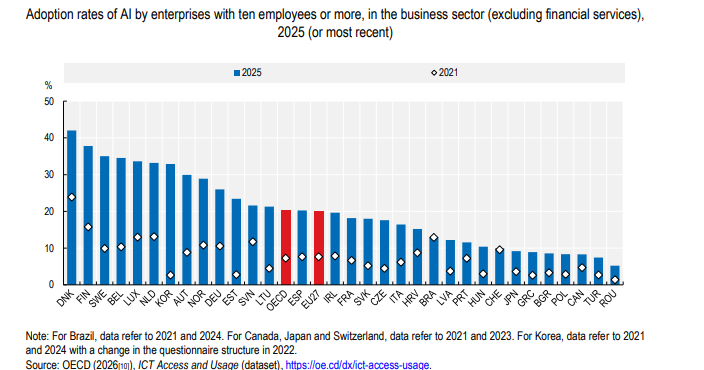
The OECD confirms this challenge in its study Skills in the AI Age, stating that the lack of skills is the second most important barrier for small businesses to adopt artificial intelligence-based technologies. In other words, the main challenge is not only technological; it is also about capabilities.
"This means that digital transformation will not only depend on the available platforms but on the ability of entrepreneurs to continuously learn, interpret information, and turn data into decisions that strengthen their business."
Just as two decades ago learning to use a spreadsheet ceased to be an advantage to become a basic management skill, in the coming years understanding how to leverage information will be an indispensable competence for any company that aspires to grow sustainably.
Before talking about artificial intelligence, SMEs need to build something even more important: organized, connected businesses capable of making better decisions based on their own data. This is still considering that companies have significantly increased the adoption of AI in recent years.