
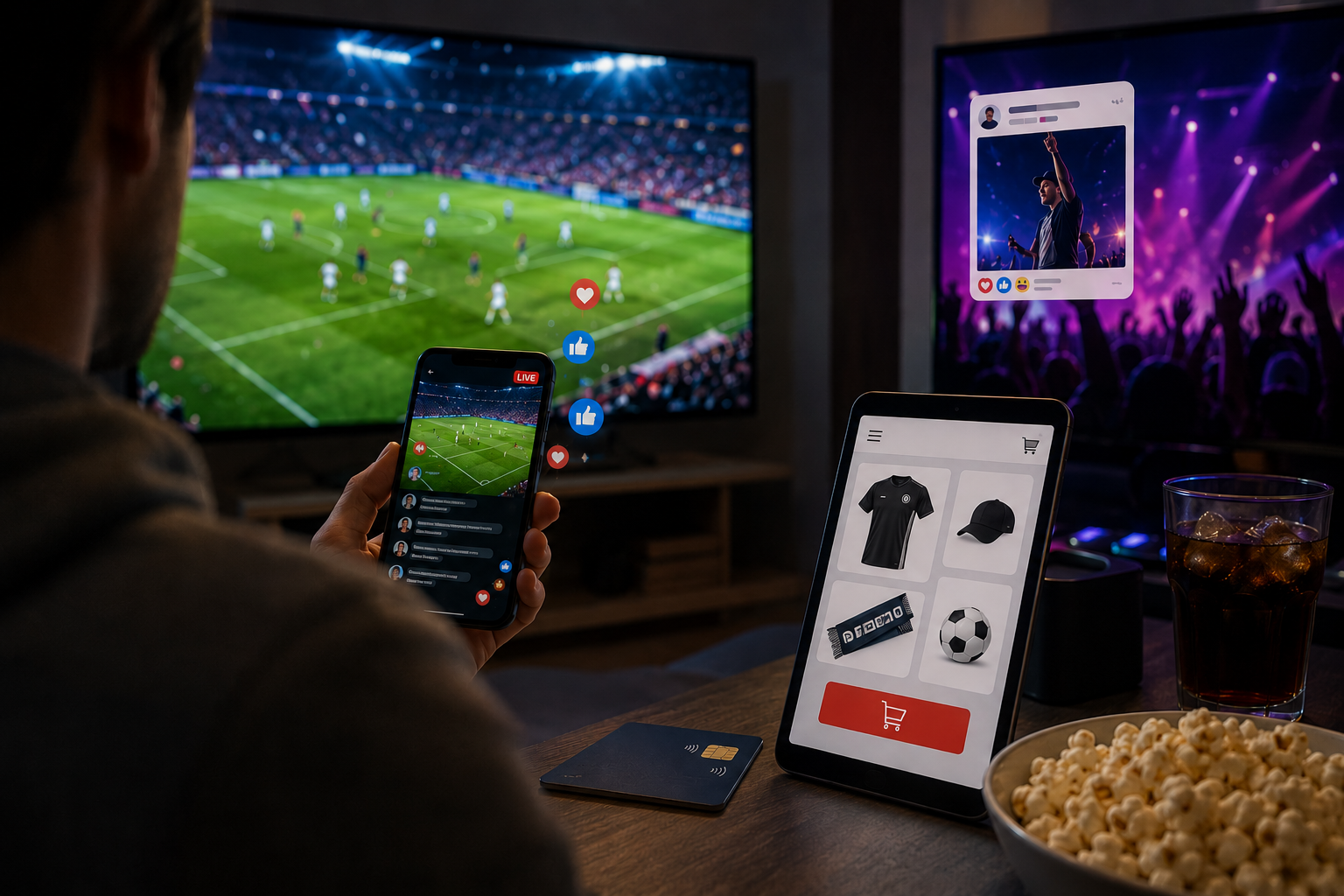
When consumer attention is fragmented across multiple screens, major sporting events and mass spectacles are no longer just entertainment spaces but become real-time commerce laboratories. In the digital economy, attention has become the scarcest asset for businesses. Every notification, video, advertisement, and post competes for just a few seconds of the user's time. However, there are moments capable of breaking this fragmentation and bringing millions of people together around the same conversation. The consumer no longer distinguishes between entertainment, social media, and e-commerce: everything happens simultaneously and from the same screen. For brands, retailers, digital platforms, and technology companies, this transformation represents a structural change in how purchasing decisions are made, where organizations must focus on transforming every high-audience moment into digital experiences capable of converting intention into business.
In Mexico, according to the behavior indicators of the Mexican Association of Online Sales (AMVO), about 80% of the population claims to be football fans. Paradoxically, less than 1% have the opportunity to regularly attend a stadium, and a large portion of the most relevant matches are played during working hours. Far from diminishing interest, this reality has completely transformed the way people consume sports: the current fan follows the game from an open tab on their office computer, checks the score from their cell phone during a meeting, comments on plays on social media, and, at the same time, orders food, drinks, or buys products related to the event. This is how the so-called "digital stands" are born, a behavior that reflects how users integrate entertainment, social interaction, and unified commerce into a single experience.
However, limiting this dynamic to sports would be to ignore one of the most relevant transformations in digital consumption. Concerts, music festivals, movie premieres, tech launches, and even viral phenomena now generate very similar behavioral patterns. The Bad Bunny phenomenon or the logistics behind major international concerts in Mexico City clearly illustrate this evolution: the experience no longer begins when the venue doors open or ends when the lights go out. Days before the show, economic activity is unleashed, encompassing official merchandise purchases, accommodation reservations, mobility app requests, restaurant consumption, and transportation. What was once an isolated event now represents an economic ecosystem that simultaneously mobilizes multiple industries, demonstrating that categories such as food, beverages, delivery, retail, betting, fintech, and e-commerce experience significant increases during high-audience moments.
In this new context, contextual marketing surpasses static sponsorship. For decades, event marketing relied on gaining visibility through logos on uniforms, stadium advertisements, or traditional commercial spaces during broadcasts. This model remains relevant for building brand awareness but is insufficient for a consumer who interacts on social media, consults statistics, and makes transactions from their mobile device simultaneously. The best-performing campaigns are those capable of interpreting the user's emotional context. An outstanding example of this advertising transition is the campaign developed jointly by Nu Mexico and Netflix for the return of the Club de Cuervos series. Under the concept "Club Sin Peros," the campaign used humor to connect with a common situation: millions of people working while their favorite team played. Instead of focusing communication on the technical features of a financial product, the strategy built a relatable narrative that later directed the user towards opening a digital account, demonstrating that the difference lay in understanding the cultural moment the audience was experiencing.
Market data used for the campaign:
The campaign relies on several data points that justify the insight:
- Between 70% and 80% of Mexicans consider themselves football fans (Nielsen 2024 and Statista 2025).
- It was estimated that only 0.7% of the population would have access to official events in Mexico.
- Approximately half of the matches would be played during working hours.
While creativity attracts audience attention, it is the technological infrastructure and data that convert that interest into measurable business results. Each audience peak also represents a sudden increase in digital traffic, simultaneous transactions, and queries on e-commerce platforms. Brands focused on transactional solutions like Clip have understood that sports conversations also boost the local economy in small businesses and neighborhood restaurants, where having fast and reliable digital payments makes the difference between capturing or losing that instant economic spillover. The lesson extends beyond sports: in an environment where purchasing decisions occur in seconds, any friction immediately translates into losses. According to Baymard Institute's global usability studies, the average shopping cart abandonment worldwide exceeds 70%, and a substantial part of these losses is directly related to complex payment processes, unexpected costs, or poor digital experiences. This confirms that technological infrastructure is no longer a purely operational pillar but has become a strategic growth asset.
For leaders in e-commerce, marketing, and digital transformation, three fundamental capabilities will differentiate the most competitive organizations:
- Real-time data activation and interpretation: The 90 minutes of a match or the trend of an event constitute a unique commercial window. Understanding what happens and how audiences react allows for automating contextual promotions, such as specific offers during halftime, coupons after a goal, or benefits at the start of a concert, responding when the probability and intention to purchase reach their highest dopamine point.
- Frictionless experiences and resilient ecosystems: A successful campaign loses all its value if the platform does not support a sudden increase in massive traffic. Ensuring agile payment processes, stable gateways, cloud architecture, and minimal server response times is now an indispensable requirement to compete and avoid abandoned carts.
- Relevance over saturation: Today's consumer naturally filters and blocks intrusive advertising. As advertising saturation increases, the brands that generate the best ROI are those that understand the cultural codes of their audiences and build content that provides value and integrates into the conversation instead of interrupting the experience.
Deloitte's global studies show that more than 80% of fans simultaneously use a second screen while following live events, organically switching between social media, messaging, and shopping platforms. Simultaneously, consulting firms like Statista estimate that the global Live Commerce market will maintain accelerated and historical growth, driven by consumers who expect immediate and interactive experiences. The definitive convergence between content, technology, and commerce is redefining the rules of the game. The companies that will lead the ecosystem will not necessarily be those that invest the largest advertising budgets, but those that manage to integrate creativity, data, and automation to respond to context in real-time. In the new digital economy, understanding and mastering the digital stands is an indispensable condition for building a scalable business, turning every peak of high attention into a lasting relationship of value and growth.
From next+'s perspective, the consolidation of the "digital stands" reflects that e-commerce has transformed into a dynamic process driven by context and collective emotion. The learning from this transformation is that value capture in mass events no longer depends on the purchase of traditional advertising spaces but on the technological maturity of the organization. As the boundaries between content, social media, and transactions dissolve, the competitive advantage will belong to companies capable of integrating scalable cloud architectures, real-time predictive analytics, and invisible payment gateways. Converting attention peaks into measurable revenue requires treating digital infrastructure not as an operational cost, but as the central engine of the omnichannel commercial strategy.