

One of the few things I remember from my Communication degree, which I studied over 13 years ago, is how media is constantly changing and how each medium must “remediate” itself.
This is what has also happened with advertising. And I'm not just referring to the new platforms or formats that have emerged, but to something much deeper:
The way people consume content and their ability to decide whom to trust, whom to follow, and what type of content to consume.
What we are experiencing is not simply an evolution of the media, but a transformation of the influence model. For decades, brands controlled the message and media controlled the distribution. Today, the most valuable asset is the trust of a community.
This transformation is driving an industry that continues to grow at double digits. According to Statista, the global influencer marketing market reached an estimated value of over 32 billion dollars in 2025, consolidating itself as one of the fastest-growing marketing categories worldwide.
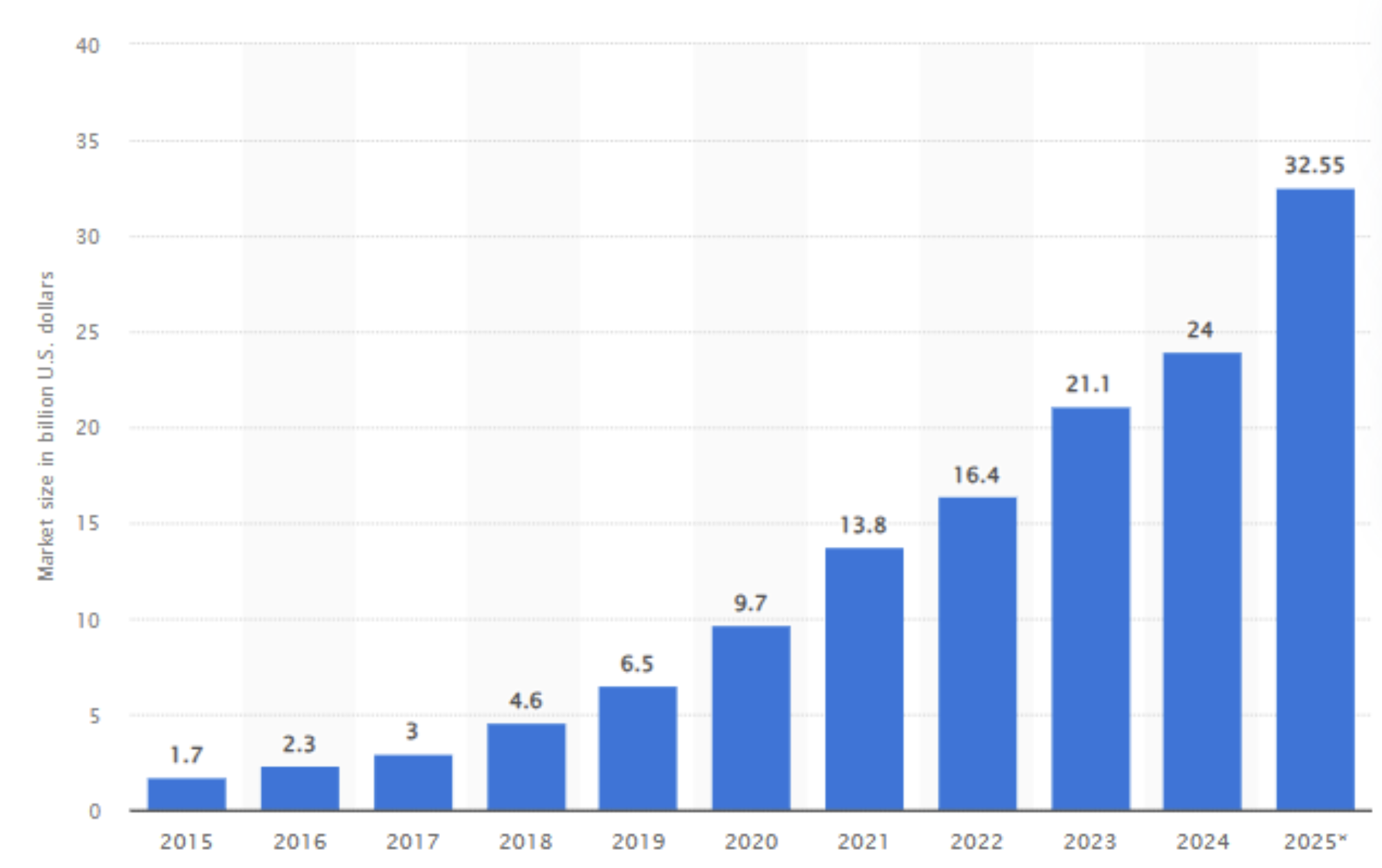
I believe this is key to emphasizing that influencers are no longer a trend, but one of the most powerful tools for advertising today.
The conversation no longer revolves around whether brands should work with content creators, but rather how to do so strategically, measurably, and aligned with business objectives.
How has advertising changed? From traditional media to influencer marketing
For many years, advertising coexisted in traditional media such as magazines, billboards, and television. These were the main channels for connecting with audiences.
I myself was part of that era when I worked at Editorial Televisa selling advertising in magazines like Cosmopolitan, TV y Novelas, Men's Health, and National Geographic, among many others.
But I was also part of the transition to digital.
It was then that magazines had to “remediate” themselves, opening social networks and developing websites as new commercial spaces.
In parallel, with the arrival of Instagram in 2010, the talents we previously only saw on television began to build their own audiences. Following the lives of your favorite celebrities and feeling close to them was just a click away.
This completely changed the dynamic: brands stopped relying solely on traditional media and began collaborating directly with people who already had the public's attention and trust.
The difference is that before, advertising interrupted content; today, content is advertising. Creators integrate commercial messages into conversations that are already part of their audiences' daily lives, reducing friction and increasing relevance.
Moreover, the growth of platforms like TikTok, YouTube Shorts, and Instagram Reels accelerated a new attention economy, where the ability to generate engagement outweighs media investment. This allowed profiles with highly specialized communities to compete in influence with traditional celebrities.
Why have influencers become a basic bet for brands?
In my opinion, the value of influencers lies primarily in community building and the trust they generate with their audience.
These are people who have developed a constant relationship with their followers, making their recommendations feel much more personal and authentic.
However, limiting the value of influencers solely to closeness would be oversimplifying the phenomenon. Today, brands consider them a channel capable of generating awareness, consideration, traffic, sales, and loyalty.
Social media offers a much more precise level of measurement. Not only do they allow real-time performance of each piece of content to be known, but they also facilitate direct actions such as purchase links, discount codes, and attribution systems.
The ability to connect exposure with conversion has turned influencer marketing into an increasingly results-oriented discipline. Various industry studies estimate that brands generate, on average, between 5 and 6 dollars for every dollar invested in campaigns with content creators.
Added to this is an important factor: efficiency.
In many cases, working with influencers can be more accessible and agile than producing a traditional advertising campaign.
But perhaps the most relevant change is that audiences have also changed. Consumers are increasingly skeptical of traditional advertising and seek recommendations from people with whom they share interests, lifestyles, or values.
For this reason, the most advanced brands are evolving from isolated campaigns to long-term relationships with creators. They are no longer seeking only reach; they are seeking to build sustained credibility within specific communities.
The key is not to hire influencers, but to know how to choose them.
After 10 years of experience in this field, I believe that one of the biggest mistakes in influencer marketing is in talent selection.
As a manager of 33 content creators, it’s something I see constantly: brands choosing profiles based on personal affinity rather than strategic logic.
For years, the main selection criterion was audience size. Today, we know that this variable, by itself, says very little about the potential impact of a campaign.
The correct questions are different:
- Is there a real affinity between the community and the brand?
- Does the creator share values compatible with the organization?
- Does their audience match the consumer profile that is sought to be reached?
- Have they demonstrated the ability to generate conversation, consideration, or purchase?
The industry is moving towards models where relevance outweighs volume. In many cases, micro-influencers and niche creators generate higher engagement and conversion rates than massive profiles, precisely because they maintain a closer relationship with their audience.
The reality is that, as with any type of advertising, results also involve trial and error.
There may be an apparent perfect match between the profile and the brand, but when it comes to collaborating, the expected response is not obtained.
However, when the selection is correct, the results can be overwhelming.
A clear example is the collaboration between GAP and one of our top talents in the agency: Marii Molly, where we worked together on the development of some pins.
The project was planned for a six-week duration, but by the third week, the product was already completely sold out.
Additionally, considering that the launch occurred during one of the most saturated commercial seasons of the year, approximately 85% organic reach was achieved.
Beyond immediate sales, this case demonstrates one of the greatest strengths of modern influencer marketing: the ability to mobilize communities around an idea, a product, or a cause in an organic and credible way.
The next challenge: measurement, transparency, and trust
As investment in influencer marketing continues to grow, so do the demands for measurement, transparency, and regulatory compliance.
Organizations are increasingly seeking to attribute concrete results to their investments in creators, integrating business metrics such as cost of acquisition, return on investment, lead generation, and customer lifetime value.
At the same time, transparency in commercial collaborations will be a critical factor in preserving consumer trust. Authenticity, which has historically been the main asset of influencers, will also become the main evaluation criterion for brands and audiences.
Conclusion
In an environment where attention is increasingly difficult to capture, influencers have established themselves as one of the most relevant tools for advertising.
However, their effectiveness does not lie solely in reach or in the ability to convey a message.
Their true value lies in something much rarer: trust.
Brands that understand this transformation will stop seeing creators as a tactical channel and begin to integrate them as part of a broader strategy for brand building, demand generation, and growth.
Because the future of advertising does not necessarily belong to those with the largest budget, but to those who manage to build the most relevant relationships with their audience.