

The technological evolution in the search, valuation, and selection of commercial properties in Mexico
The commercial real estate sector in Mexico is experiencing an unprecedented revolution driven by a central theme: the new proptechs and the use of data for increasingly smarter decision-making. The days when investments depended solely on intuition or slow and inefficient manual processes are behind us.
For investors, entrepreneurs, and logistics managers, the digitization of the search for commercial spaces has ceased to be a convenience and has become a vital competitive advantage. By leveraging advanced technological platforms, industry leaders can now access inventories of industrial warehouses, land, and offices with pinpoint precision.
This transition to digital not only optimizes time but also mitigates operational and financial risks. In this article, we explore how real-time information has become the compass for success in physical businesses, answering key questions about the impact of data, the role of artificial intelligence, and the evolution of real estate platforms.
The real estate marketplace as a business infrastructure
The traditional model of searching for properties is a thing of the past. Today, when we ask ourselves: How is the real estate marketplace model evolving?, we understand that these platforms are no longer just simple catalogs or bulletin boards; they have become a robust, comprehensive business infrastructure.
At Spot2.mx, the digitization of the search for commercial spaces allows the centralization of supply and demand in a highly efficient ecosystem. Investors and entrepreneurs now interact in digital environments that integrate multimedia, automated document management, and real-time legal validation. This evolution transforms a process that used to take months into an agile experience of just weeks. The modern marketplace acts as a strategic partner that facilitates the exact connection between a company's operational needs (such as a logistics hub or a retail point of sale) and the ideal real estate asset, removing friction and optimizing transaction costs.
Marketplaces of this kind have evolved to transform into a comprehensive business infrastructure (Proptech as a Service). It is no longer just about connecting supply with demand, but facilitating the entire transaction lifecycle.
A modern marketplace for commercial properties no longer just centralizes market intelligence, legal document management, and property verification in a single ecosystem. It becomes a strategic partner that offers:
- Advanced search filters based on zoning requirements, electrical capacity, or ceiling height for industrial warehouses and other types of commercial properties.
- Multimedia of the complex and access to plans that save dozens of hours in physical visits.
- Data-driven support for negotiating long-term lease contracts.
This evolution ensures that companies can scale their physical operations with the same agility with which they scale their software.
Real estate data as a strategic asset
In the current corporate environment, intuition is no longer enough; data-driven information is the key to success. But, how does real estate decision-making change with data? Radically. Real estate data as a strategic asset allows logistics directors and investment funds to analyze critical variables before committing capital to any location.
By centralizing data on traffic flows, demographic density, logistical connectivity, and price trends per square meter, companies can identify hidden opportunities and mitigate risks. Instead of relying on superficial estimates, users of advanced platforms can visualize commercial maps and historical performance metrics of the area.
This means that the selection of land or a corporate office becomes a purely analytical and predictable decision, ensuring that every investment is backed by solid indicators that guarantee a strong and long-term return on investment (ROI).
The impact of artificial intelligence in the sector
Artificial intelligence (AI) is the silent engine that is redefining commercial real estate in Mexico. Instead of relying on traditional appraisals that can take weeks, AI algorithms process thousands of variables in seconds to provide dynamic and accurate valuations.
This technology analyzes everything from macroeconomic factors to local zoning permits, adjusting property values in real-time. Additionally, AI-driven demand forecasting allows developers and investors to anticipate the market.
For example, AI can predict which industrial corridors in Bajío or Northern Mexico will experience a demand spike due to nearshoring, before it happens. This empowers users to capitalize on emerging trends instead of merely reacting to them.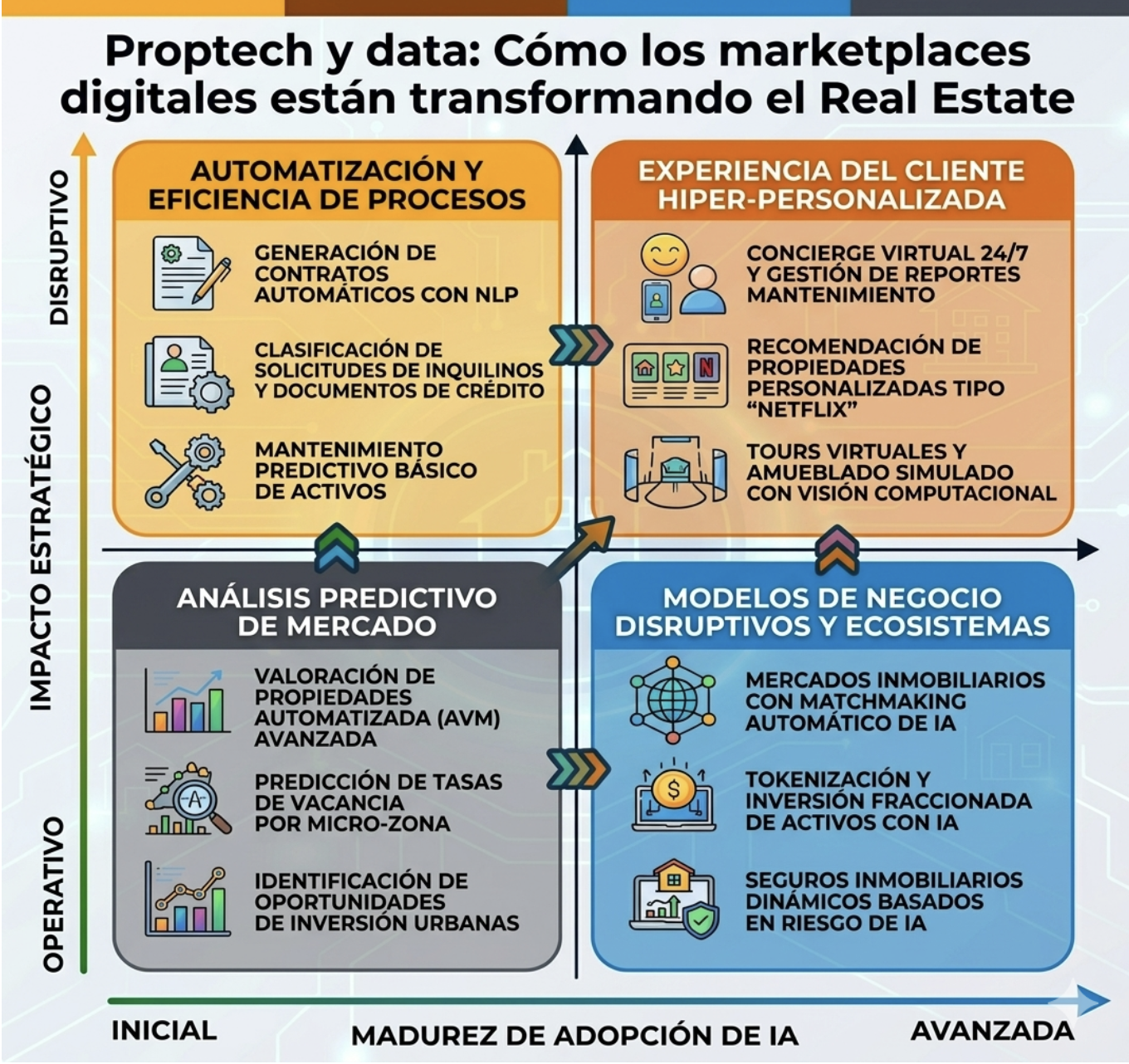 Finally, the intersection of proptech, data analytics, and digital platforms is completely redefining the commercial real estate sector in Mexico. The ability to use artificial intelligence to predict demand, along with treating data as a strategic asset, gives companies an unparalleled competitive advantage to expand their operations.
By adopting these technologies, business leaders can make safer, faster, and more profitable real estate decisions. Use platforms like Spot2.mx when creating your account to find your ideal property.
Easier, faster, and safer.