
The first half of 2026 marked a historical record in the sale of electrified vehicles in Mexico. From January to June, 95,037 units were sold, including hybrids, plug-in hybrids, and pure electric vehicles, a 44% growth compared to the 65,991 units in the same period of 2025, according to data from the Mexican Automotive Industry Association. Conventional gasoline-powered cars grew by 1.4% in the same period. Electrified vehicles grew 30 times faster and now represent 12.6% of all new cars sold in the country, compared to 9.2% a year ago. More than 1 in 8 new cars in Mexico is green.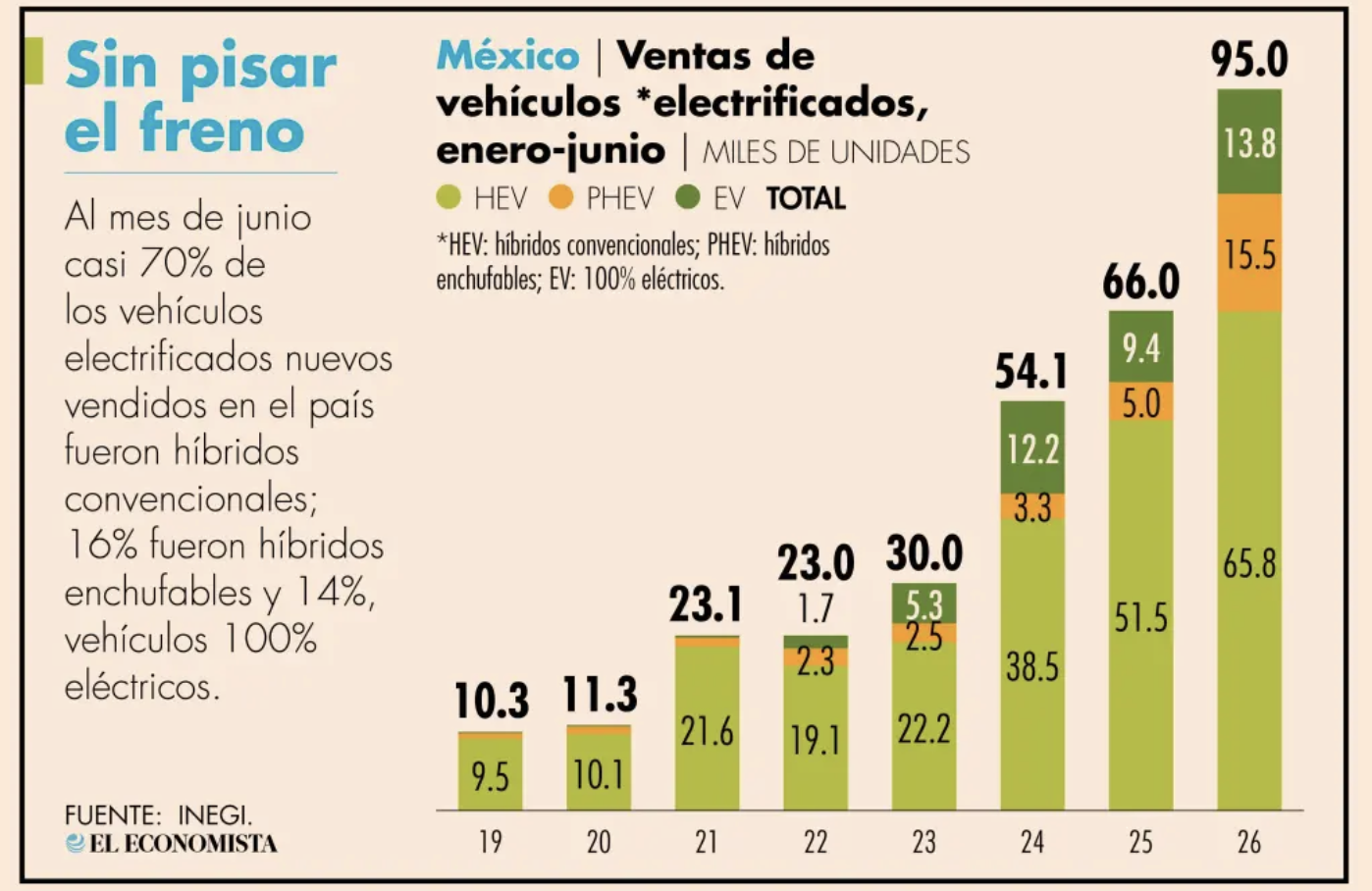 Source: El Economista / INEGI.
But "electrified vehicle" does not describe a single category. There are three, and the difference between them explains practically everything that is happening in the market.
Conventional hybrids, which combine a gasoline engine with an electric one and never need to be connected to a charger, lead with 65,805 units sold, 69% of the total, and grew by 27.8%. Plug-in hybrids, which allow driving a certain distance on pure battery if charged externally, accounted for 15,464 units with a growth of 207%, the largest percentage jump in the segment, driven mainly by Chinese brands such as BYD, MG, Geely, and Changan. Pure electric vehicles, which run solely on battery and require external charging, sold 13,768 units with a growth of 47.5%, but with a decreasing monthly trend.
The explanation for why pure electric vehicles are growing slower than the other two categories lies in infrastructure data. Mexico has approximately 60,000 charging points, but only 7.3% are publicly accessible. The remaining 92.7% are installed in private garages. For consumers who do not have their own garage or who live in an apartment, home charging is inaccessible, and the public network is insufficient to cover the range anxiety generated by pure electric vehicles. The conventional hybrid solves this problem at its root: it consumes less fuel, does not require charging planning, and does not demand any investment in home infrastructure.
In the hybrid segment, Toyota dominates widely. In plug-in hybrids, Chinese brands are taking control. The EMA recorded 170 models available in Mexico: 110 pure electric and 60 plug-in and extended-range hybrids.
The most striking contrast of the semester occurs in production, not in sales. While the domestic market breaks records, national manufacturing of electrified vehicles destined for export fell by 57%, from 110,002 units in the first half of 2025 to 47,411 in 2026. The collapse is concentrated in models that Mexico manufactures for the US market: GM's Equinox EV fell 81.6%, from 38,995 to 7,185 units, and the Blazer EV fell 80%, from 10,469 to 2,099 units. The cause is the drop in demand for electric vehicles in the United States, where the withdrawal of tax incentives and tariff uncertainty curbed purchases. The manufacture of electric cars in Mexico began in 2020 with Ford and expanded with GM, Toyota, and Stellantis as long as there were incentives in the US market. Today, that momentum has cooled.
For the next+ team, the first half's data describe two stories happening simultaneously in Mexico with different consequences for each actor in the automotive ecosystem. The first is that of a domestic market that adopted electrification faster than expected but did so through the path that requires the least infrastructure: the conventional hybrid. This is not a sign of maturity of the electric ecosystem; it is a sign that consumers are avoiding the friction of a public charging system that does not yet exist on the necessary scale. The 7.3% of public charging points is not the result of a lack of demand; it is the limitation that holds back the demand for pure electric vehicles. The second story is that of an exporting industry that built installed capacity for an external market that contracted. These two stories point to the same gap: the missing business in Mexico is not what car to sell, but where to plug it in.