
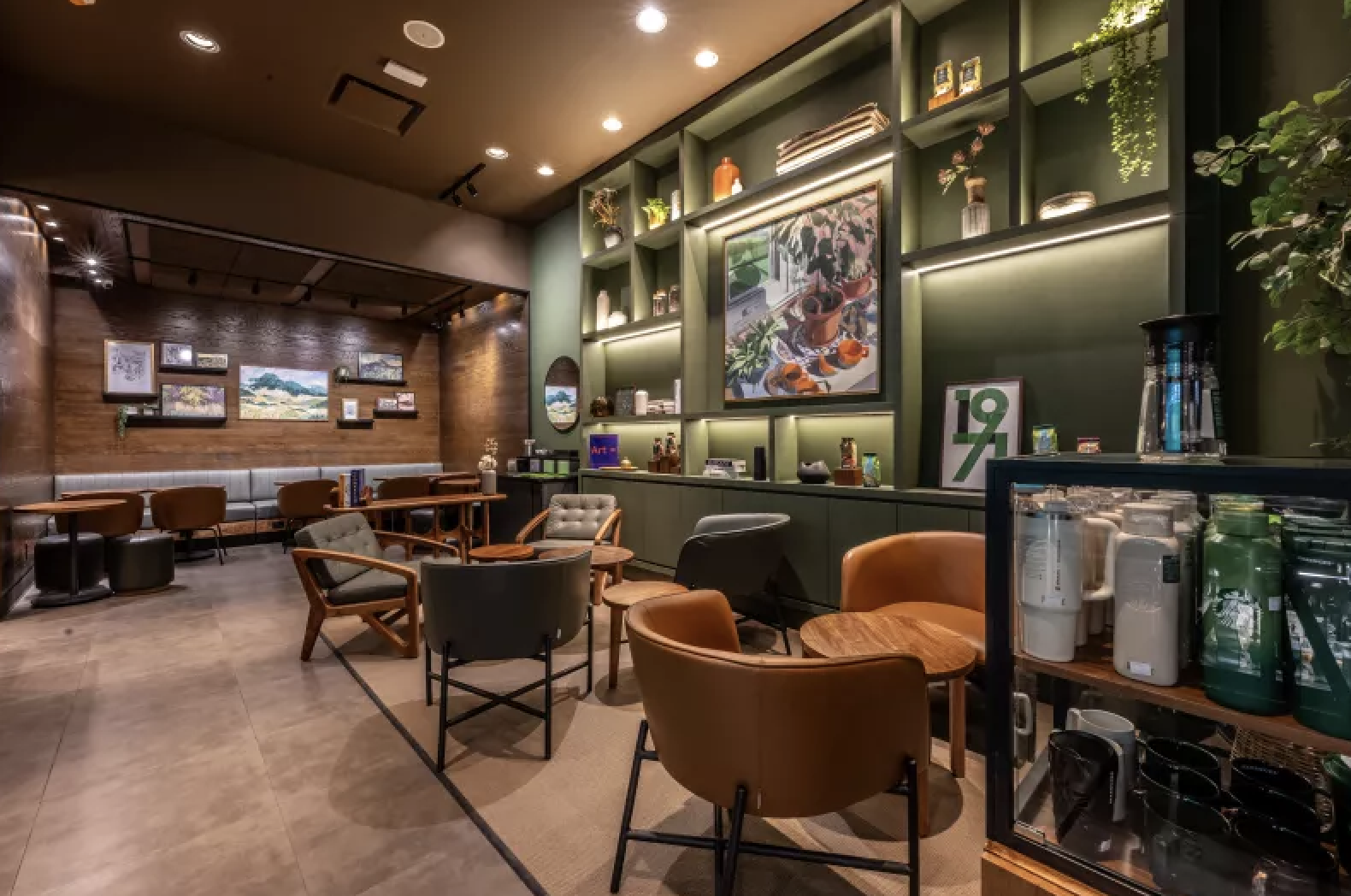
Alsea and Starbucks renewed their alliance until 2046 and with that began a second phase of their relationship in Mexico that changes the focus of the strategy: the next chapter of growth will no longer be measured by how many coffee shops are opened, but by what happens inside them.
This year Starbucks will open more than 60 stores and remodel more than 80 in Mexico, where the chain is close to reaching 1,000 units. But the center of the bet is not on those numbers. It is on Coffee House Uplift, a global concept that Mexico is launching as a pilot market in Latin America, an initiative that has already intervened in more than 1,000 stores in cities such as New York, Chicago, and California.
The concept does not apply the same format to all locations. The idea is to adapt each store to the specific context of its clientele: a coffee shop near a university will have community tables; one next to a hospital will have a different layout. Changes include different lighting, natural plants, references to the origin of coffee, acoustic improvements, armchairs, and spaces designed for different consumption occasions. The aim is not just for the customer to come in to buy a drink, but to find reasons to stay.
"We don't want to open stores just to open stores. It's not a race to open more stores, nor is it a race to generate productivity," said Diego Recalde, CMO of Starbucks. The company measures its evolution through in-store traffic, average ticket, brand health, and customer satisfaction, not just by the number of openings.
The bet has concrete backing in loyalty data. Starbucks Rewards already represents almost 40% of the chain's sales in Mexico, a figure that confirms that retention and recurrence are the most important indicators at this stage.
Mexico's weight within the regional strategy is also no coincidence. With more than 950 stores operated by Alsea, the Mexican market has the brand's largest portfolio in Latin America under that operator. José Pozo, director of Coffee House Expansion for Latin America for Starbucks, acknowledged that the structure that Alsea has developed in Mexico over 25 years is what makes the country the regional laboratory for this concept. "Alsea is Starbucks' strategic partner in Latin America. It has Starbucks' full confidence and has done an excellent job over the past 25 years," said Pozo.
For the next+ team, Alsea and Starbucks' move illustrates a trend that is redefining the logic of experiential retail globally: when a brand reaches sufficient density of points of sale in a market, growth ceases to be measured in square meters and begins to be measured in depth of relationship with the consumer. That Starbucks Rewards represents 40% of sales in Mexico is evidence that a significant part of the customer base already has a bond with the brand that goes beyond the transaction. Coffee House Uplift is the bet to deepen that bond from the physical space, at a time when the search for real face-to-face connections competes with digital saturation. For retail brands and restaurants operating in Mexico, the strategic reading is that the next phase of growth is not always about opening more, but about making what already exists generate more reasons to return.