
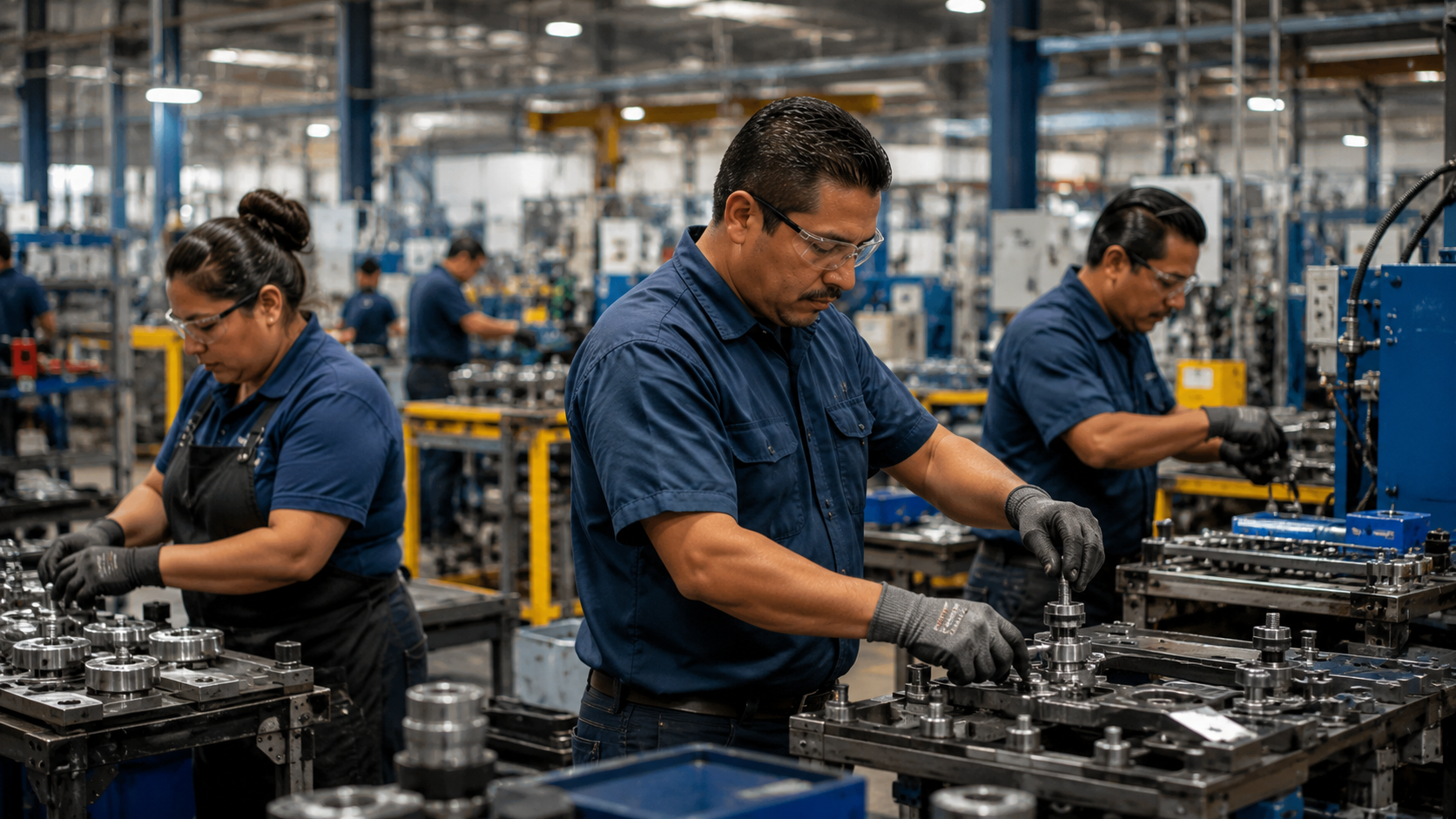
Mexico's manufacturing industry is experiencing a prolonged period of deceleration in its capacity to absorb and generate jobs. According to the latest figures from the National Institute of Statistics and Geography (INEGI), employed personnel in the manufacturing sector registered a new annual contraction in May, accumulating an uninterrupted period of 39 months of year-on-year decline. This negative streak has gradually eroded the volume of the industrial payroll, causing the total number of workers in this key sector to retreat to levels not seen since the most critical periods of the health contingency caused by the COVID-19 pandemic.
This contraction in the workforce reflects structural adjustment factors in global value chains that unevenly impact the different subsectors of the national industrial apparatus. Although dynamic branches such as the manufacture of transport equipment and electronic components have managed to maintain some stability, traditional and labor-intensive industries such as textiles, clothing, footwear, and wood product processing have recorded the most severe cuts. Added to this dynamic is a gradual process of automation and the incorporation of advanced technologies in production lines, which allows plants to maintain competitive productivity levels without the need to increase their operational personnel.
Despite the sustained decline in the absolute volume of occupation, salary indicators within manufacturing plants have shown divergent behavior. Average real wages paid in the sector registered a modest increase during the period, partly driven by minimum wage adjustments and the demand for highly specialized technical labor. However, sector analysts point out that the continuous cooling of external demand for export goods and caution in long-term industrial capital investments will continue to put a ceiling on manufacturing payroll growth during the coming quarters.
From the perspective of next+'s strategic consulting team, the 39-month streak of declines in manufacturing employment should not be interpreted solely as a symptom of economic weakness, but as evidence of a structural reconfiguration in the Mexican industrial model. For senior management and decision-makers, the industrial sector is transitioning from a scheme focused on the volume of labor-intensive work towards one focused on efficiency, automation, and added value of production. Given this scenario, transformation companies cannot expect to regain competitiveness by relying on traditional hiring models. Sector leaders must redirect their investments towards the upskilling of their existing staff and the integration of predictive technologies and advanced robotics, transforming the decrease in physical payroll into a leap in technological productivity and operational resilience.