

Insights & Execution Consulting published an analysis of the retail ecosystem in Latin America that maps the dominant players in each market of the region and identifies the competitive dynamics that are redefining who wins the battle for the consumer. The study starts from a premise that the sector knows but often underestimates in practice: Latin America is not a uniform market. It is a collection of ecosystems with distinct local logics where the global strategy does not always work and where the winners are, more often than not, those who best interpret their territory.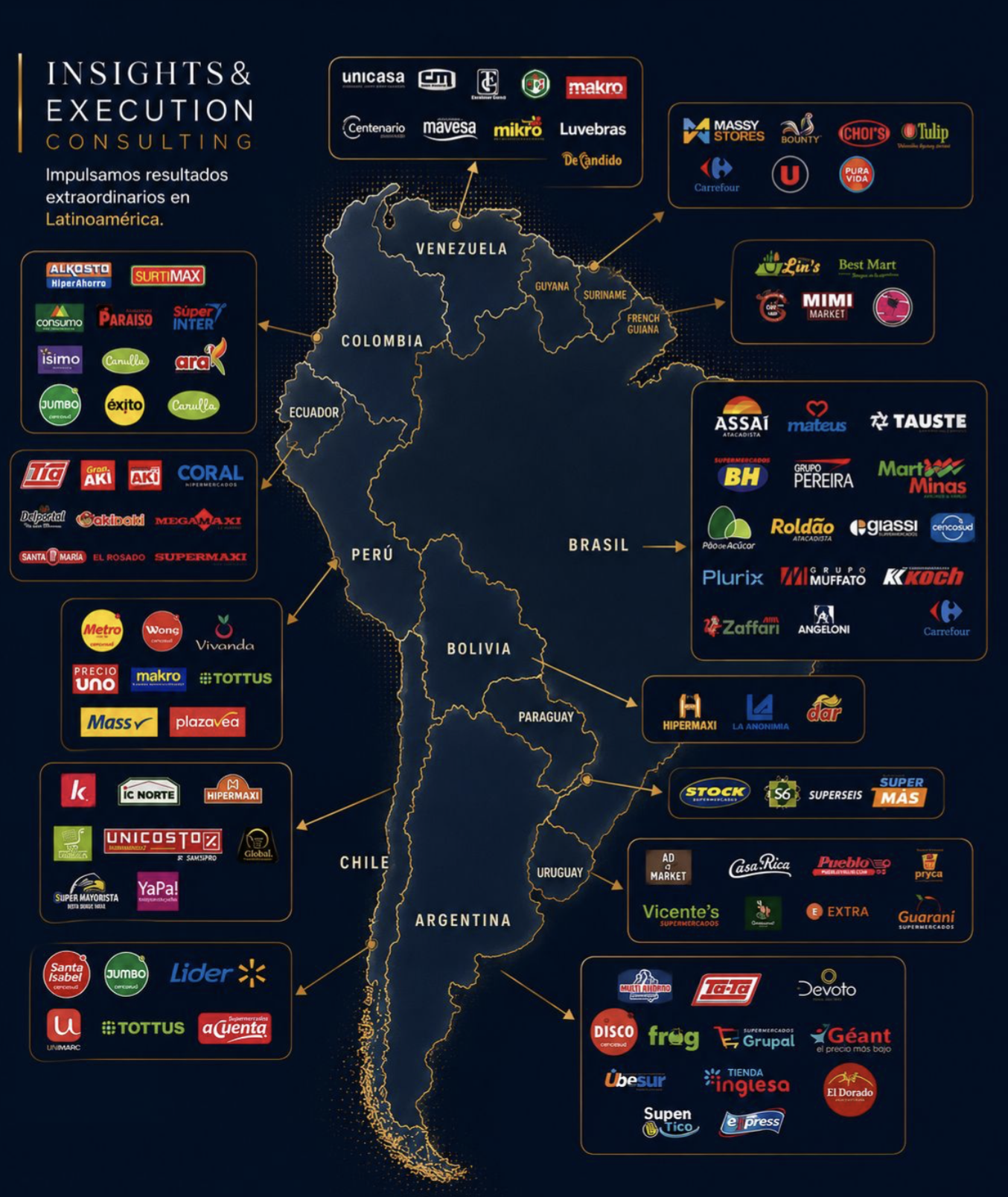 Source: Insights & Execution Consulting
The analysis by market reveals very distinct profiles. Brazil concentrates the largest scale and competition in the region, with players like Assaí Atacadista, Mateus, BH Supermercados, Grupo Pereira, Roldão, Muffato, and Carrefour, among others. The atacarejo format, which combines wholesale and retail sales in the same space, leads by price and volume and is one of the most distinctive elements of Brazilian retail compared to the rest of the region.
Colombia is undergoing a relevant transformation. The presence of Éxito, Ara, Jumbo, Carulla, and Olímpica coexists with a movement that is changing the map from below: hard discount. D1, with more than 2,750 stores, is the most compelling case of how a price and proximity-based format can redefine a market structure in a short time.
Chile presents a different profile: high concentration, sophisticated consumers who are price-sensitive, and competition that is fought mainly on operational efficiency. Santa Isabel, Jumbo, Lider, Tottus, aCuenta, and Unimarc are the names that dominate the ecosystem in a market where differentiation no longer comes from assortment but from execution.
In Peru, players like Metro, Wong, Vivanda, Tottus, makro, and PlazaVea represent a consolidated modern retail that coexists with traditional channels. Ecuador shows a similar dynamic, with the peculiarity that local hard discount is also gaining ground: Tuti exceeds 750 stores and achieves 88% penetration in households, a statistic that illustrates the speed at which low-price formats can scale when the consumer is under economic pressure.
The map also includes markets such as Venezuela, with players like Makro, Mavesa, and Micro; Bolivia and Paraguay with their own local players; Uruguay with a competitive ecosystem that includes everything from Devoto and Ta-Ta to regional chains; and Central America and the Caribbean with presences from Massy Stores, Carrefour, Choi's, and Pura Vida, among others.
From the perspective of next+, the analysis of Insights & Execution Consulting confirms five readings that the retail ecosystem in the region should be incorporating into its strategic planning. First, hard discount is not a marginal trend: in Colombia and Ecuador, it is already a structural force with sufficient scale to pressure traditional formats. Second, Brazil is a separate case study: its size and the diversity of its formats make it incomparably more complex than any other market in the region. Third, the concentration in Chile demonstrates that operational efficiency, and not store growth, is the dominant competitive variable in mature markets. Fourth, e-commerce and proximity are not replacing supermarkets in LATAM: they coexist with them and create a multichannel consumer whose behavior changes week by week. Fifth, the players that are winning are not necessarily the largest or the most global: they are the ones that have developed the ability to read their local market accurately and execute quickly. That combination, price plus data plus local execution, is the formula that the Insights & Execution Consulting analysis identifies as that of the winner in Latin America today.