
Farmacias del Ahorro introduced three technological movements in 2026 that, observed separately, could be read as independent initiatives. Seen together, they reveal something deeper: the company is rebuilding, layer by layer, the way it operates, serves, decides, and scales.
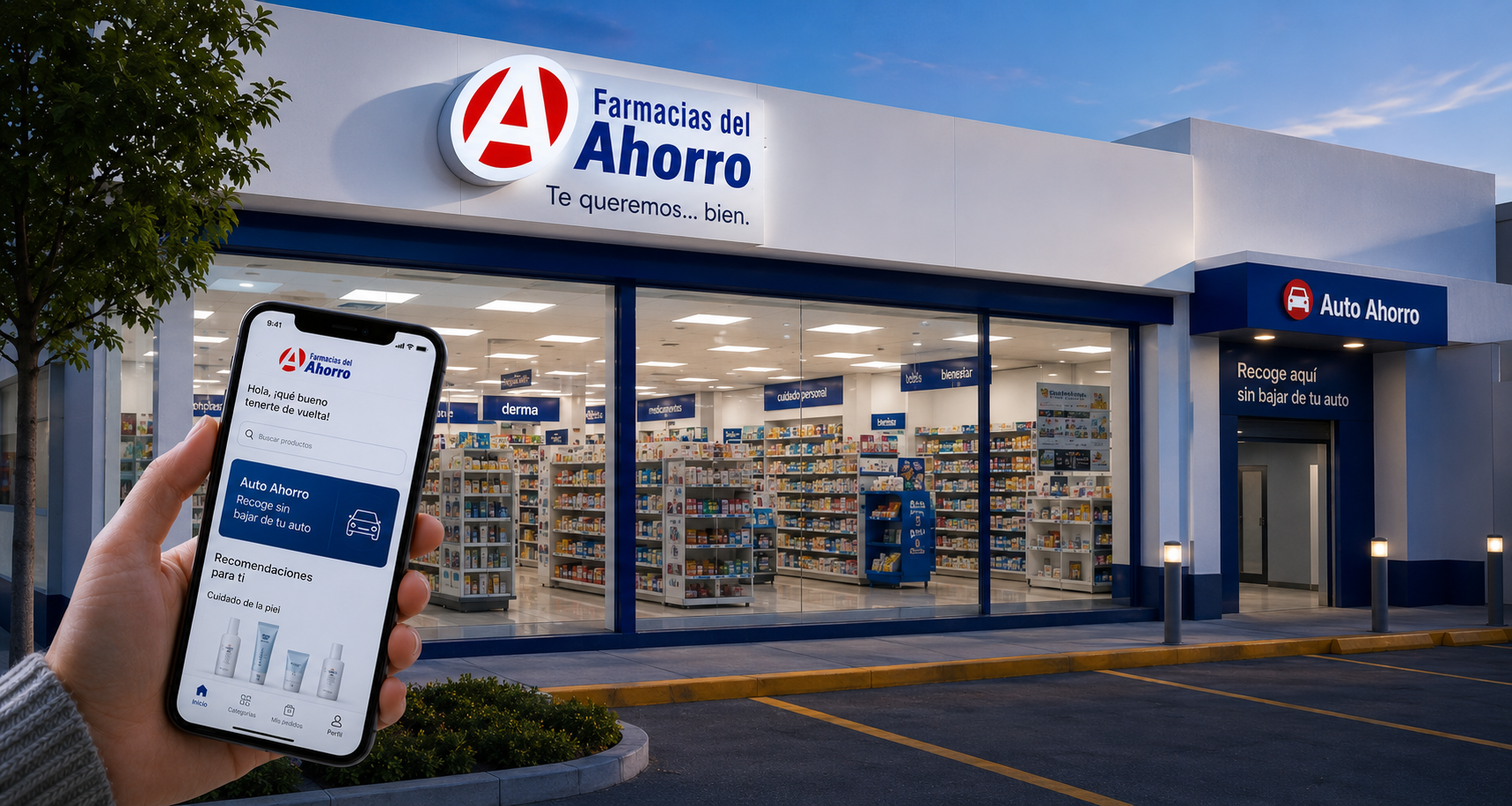
The first is visible from the branch. In Interlomas, Farmacias del Ahorro opened its most advanced unit to date: it incorporates a digital facial analysis system that evaluates hydration, pores, expression lines, and sun damage to generate personalized skin care recommendations, Auto Ahorro for picking up medicines and orders from the application without getting out of the vehicle, and more than 30 skincare brands. The relevance of Interlomas is not in the equipment but in what it represents: diagnosis, personalization, digital commerce, and in-person operation integrated into a single space. For a chain with more than 1,800 branches and more than 25,000 employees, this model needs to be replicable nationwide.
The second movement points directly to that scale. PotencIA is the program with which Farmacias del Ahorro seeks to deploy an AI-first model in 12 months using Google Cloud's Gemini Enterprise. The concrete goal: to free up 100,000 operational hours through productivity, automation, and process redesign. The strategy is divided into three phases: first, individual training and productivity; second, the incorporation of artificial intelligence agents to automate key processes throughout the organization; third, the redesign of back-office operations under an AI-first logic. an AI Council will supervise results, return on investment, and risks. Prioritized areas include Human Resources, Information Technologies, Marketing, customer experience, and e-commerce. The company expects that by the end of 2026, most of its more than 25,000 employees will use AI tools in their daily activities.
The third is the least visible to the consumer but the most structural. Farmacias del Ahorro migrated its digital operation to a private cloud architecture on Red Hat OpenShift to improve real-time inventory availability, optimize computing and memory resources, reduce over-provisioning, and maintain continuous 24-hour operation. In a pharmaceutical chain, inventory accuracy is not a secondary operational data point: it determines the promise presented to the customer in the digital channel, the reliability of the order, and the delivery capability. When this information fails, the experience is broken even if the application has an efficient interface. The new architecture also opens the door to exploring Red Hat OpenShift AI to develop predictive services and strengthen decision-making.
The relevant thing is not that Farmacias del Ahorro is using facial analysis, Gemini Enterprise, or a private cloud. The relevant thing is the articulation of these three layers. A personalized recommendation in-store has limited value if it is not related to product availability. An AI agent can automate tasks, but it will be ineffective if it works with fragmented information. An application can receive orders, but the delivery promise depends on the accuracy of the inventory and the integration with the branch that will prepare the product. Technology begins to generate operational advantage when these pieces function as a system, not as independent projects.
For next+ analysts, the Farmacias del Ahorro case is one of the most complete that Mexican pharmaceutical retail has presented regarding comprehensive digital transformation. Most chains in Mexico have opted for isolated layers: an app, a chatbot, a concept branch. What Farmacias del Ahorro is building is different in structure: a connected store, an organization with AI as an extended operational capability, and infrastructure prepared to support digital growth without interruptions. The real challenge will be to demonstrate that this model can be replicated in the remaining 1,800 units without losing consistency, and that the 100,000 hours freed up by PotencIA translate into faster decisions and more reliable experiences, not just a reduction in manual tasks.