
Mexico and the European Union signed the modernized version of the Free Trade Agreement between both parties, an agreement that updates the original text from 2000 with sectors that at that time did not exist or did not have the strategic weight they have today. Tariffs will decrease for more than 90% of bilateral trade, with products such as coffee and bananas approaching zero immediately.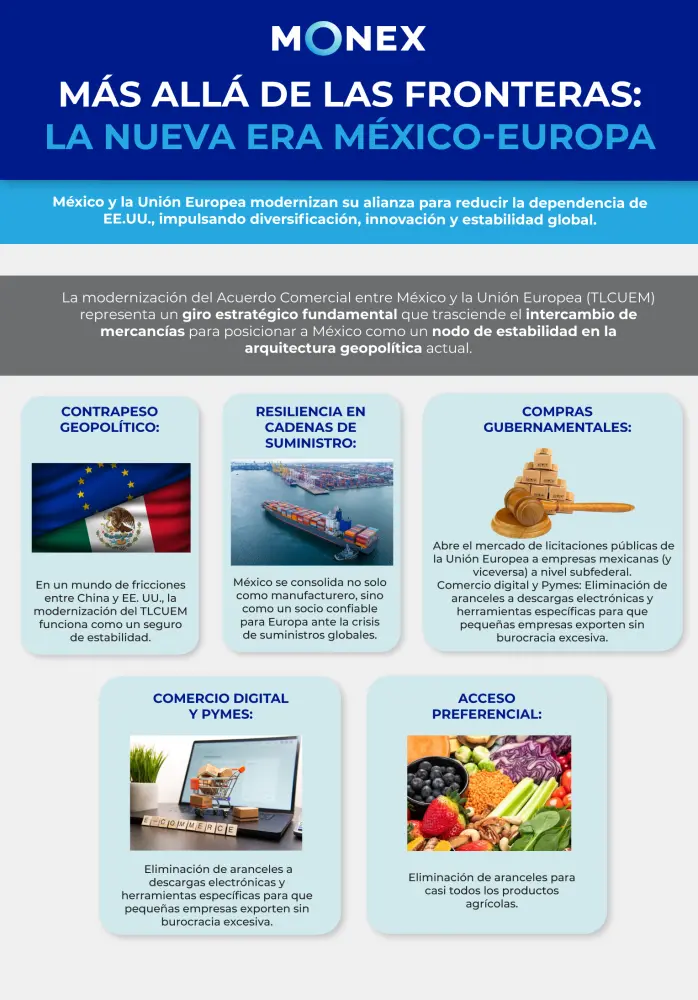
Source: Monex Analysis
The truly new aspects of the agreement are divided into five blocks that are worth reading carefully:
1. Critical minerals Europe confirmed that two or three concrete projects concerning critical minerals will emerge in the first year. Specific details have not yet been released, but the movement is explicit: the European Union needs to diversify its supply chains for strategic materials for its energy and technological transition, and Mexico is on the map as a priority supplier.
2. Energy, data centers, and artificial intelligence The agreement incorporates energy linked to data centers and artificial intelligence, a sector that did not exist in the original trade agenda of the treaty. The European Union estimates that it will need 3.5 times more energy by 2050 to meet its climate goals. Mexico enters as a partner in that equation, with European capital aiming towards energy and digital infrastructure.
3. Digital services and e-commerce In the year 2000, when the original treaty was signed, e-commerce was in its infancy. The modernized agreement removes tariffs on electronic downloads and incorporates specific tools for small businesses to export without excessive bureaucracy, opening a direct path for digital SMEs in both markets.
4. Government procurement European companies will be able to participate in Mexican public tenders at the sub-federal level, and vice versa. For Mexican companies, this represents access to a European government procurement market that has historically been closed to external players.
5. Pharmaceuticals and medical devices The pharmaceutical and medical device sector enters with an industrial cooperation scheme, an area of high added value that could trigger direct investment and technological transfer in the coming years.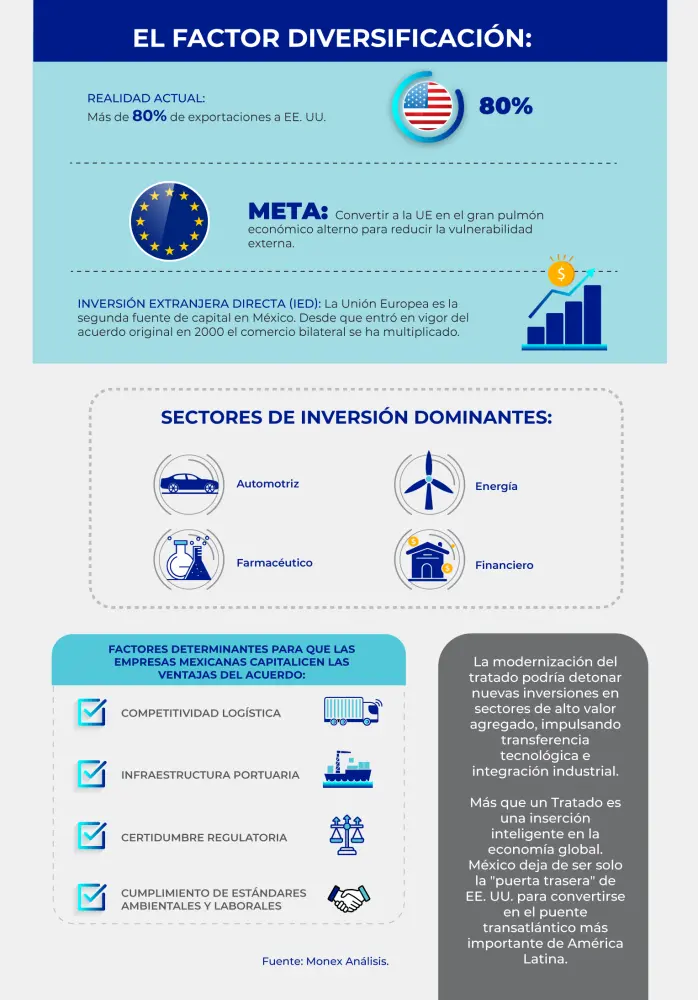 Source: Monex Analysis
The geopolitical context that explains it all
More than 80% of Mexican exports go to the United States, a concentration that the government itself recognizes as a vulnerability. The European Union already represents 24% of foreign direct investment in Mexico, and bilateral trade has quadrupled since the year 2000. The modernization of the EU-Mexico FTA is not just a technical update exercise: it is a bet to turn Mexico into the most important transatlantic bridge of Latin America, at a time when Europe has been diversifying its supply chains away from Asia and Russia for years after the shocks of the pandemic, the war in Ukraine, and tensions in the Strait of Hormuz.
The sectors of European investment with the greatest presence in Mexico include automotive, energy, pharmaceuticals, and finance, four industries that with the new agreement have additional incentives to expand their footprint in the country.
For Mexican companies that want to capitalize on the advantages of the agreement, the determining factors will be logistical competitiveness, port infrastructure, regulatory certainty, and compliance with environmental and labor standards that the European Union requires as a condition to access its markets.
From the perspective that next+ builds on commerce, technology, and business strategy, the signing of the modernized TLCUEM comes at a time when trade diversification has ceased to be an aspiration of economic policy and has become an operational necessity. For the sectors of mining, agro-industry, pharmaceuticals, technology, and digital infrastructure, European investment will not arrive in five years: the conditions for it to land in the coming months are already on the table. The next stage of that relationship, as noted by Monex analyses, positions Mexico not as the backdoor of the United States, but as a strategic node in the global economy.