

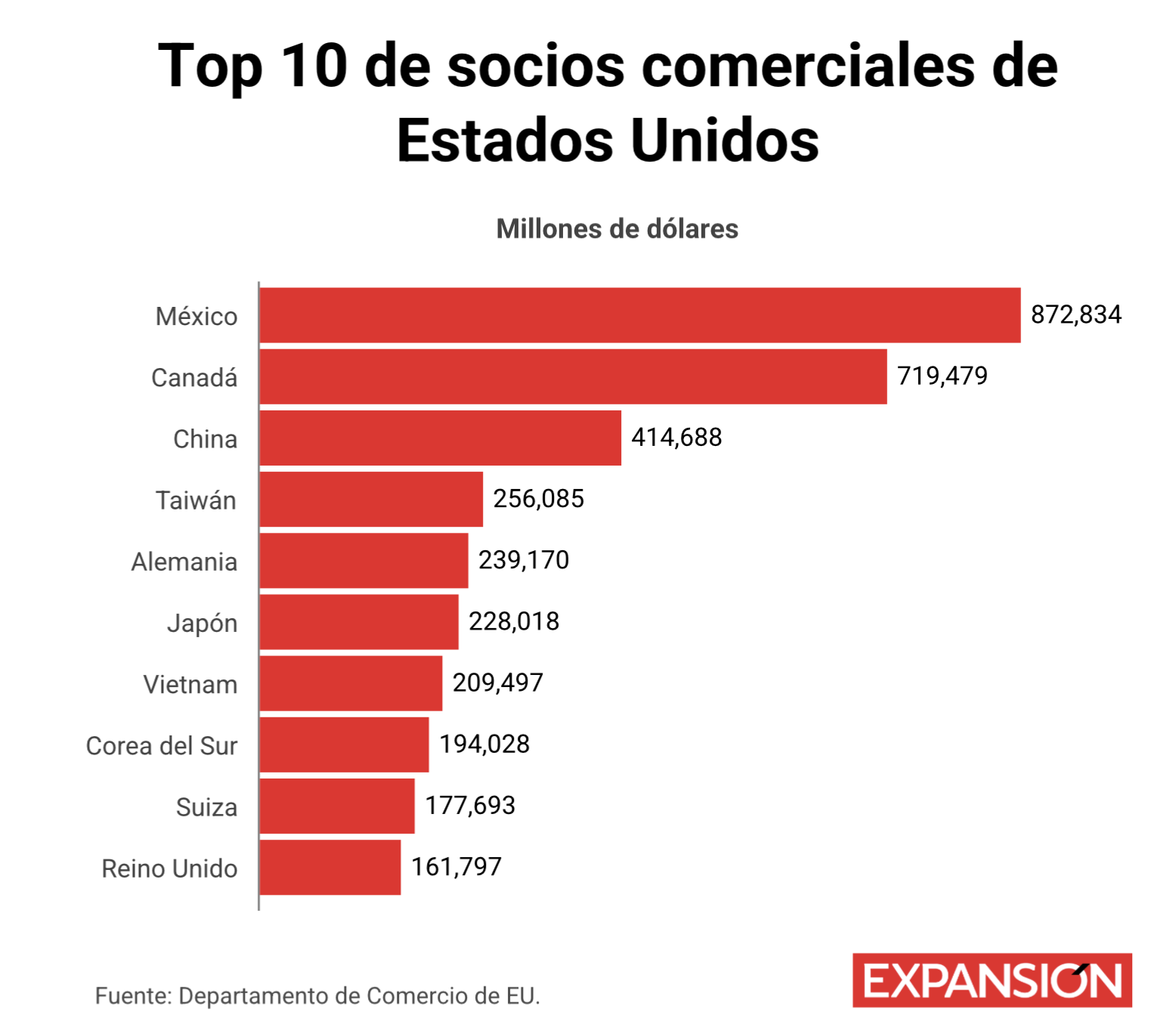
Trade between Mexico and the United States reached 872.834 billion dollars in 2025, a figure that already doubles the exchange Washington maintains with China, which closed the same year at 414.688 billion dollars. The gap confirms the gradual displacement of the Asian giant within the US market and consolidates Mexico as the most relevant trading partner of the United States.
Source: Expansión
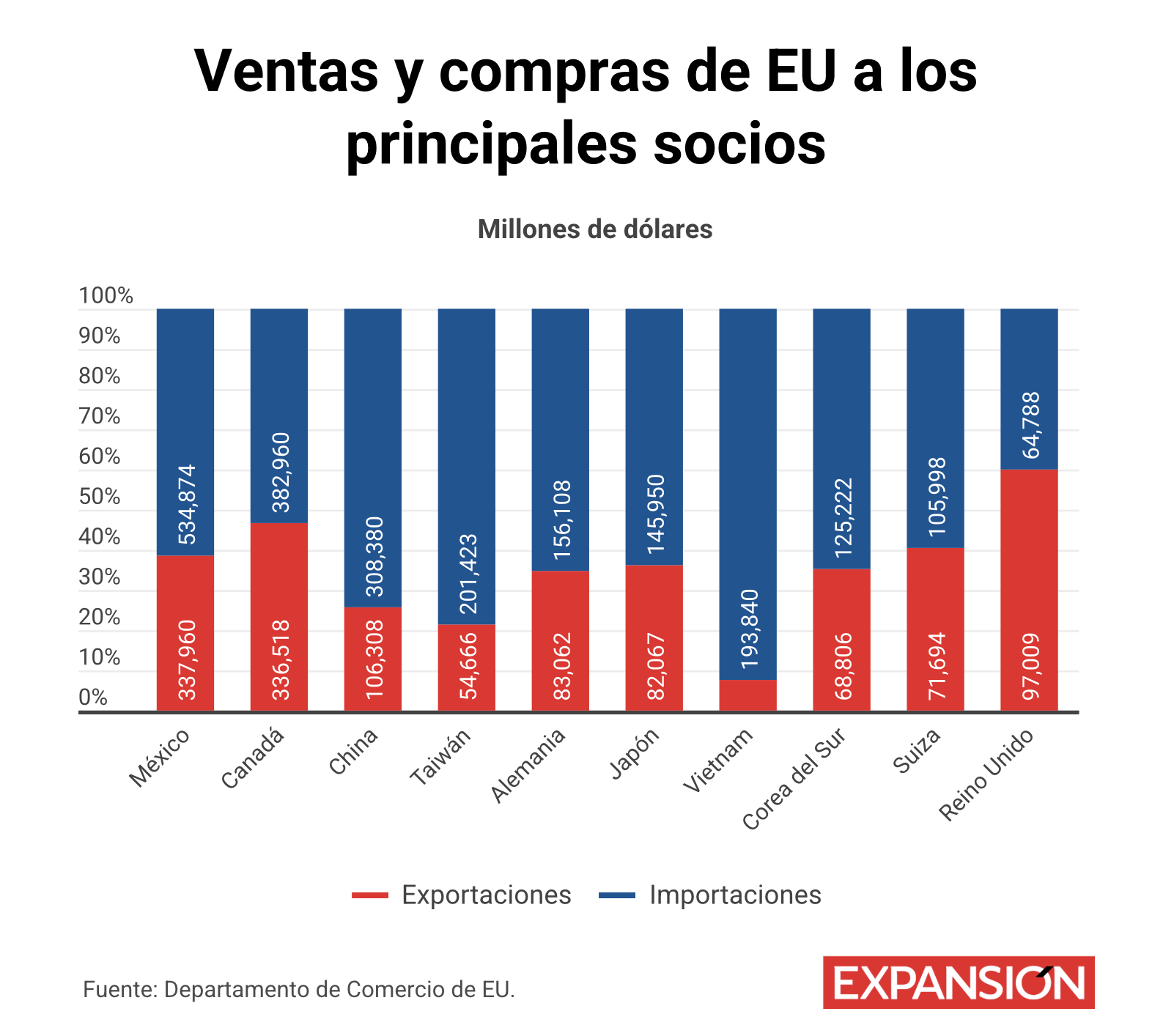
US purchases from Mexico totaled 534.874 billion dollars, an amount 1.7 times greater than what the country made from China. US exports to Mexico reached 337.960 billion dollars, almost three times more than those directed to Beijing. Mexico is not only the main supplier of goods to the United States since 2023. By 2025, it also became its largest export market, positioning itself as the first or second destination for external sales for around 75% of US industries, according to the Business Coordinating Council.
Source: Expansión
A Brookings Institution investigation indicates that this shift accelerated due to supply chain disruptions caused by the pandemic. Companies began to prioritize resilience and geographical proximity, which boosted the relocation of operations and strengthened trade within the North American region.
Among the main goods that Mexico acquires from the United States are cereals, electronics, iron and steel, auto parts, vehicles, machinery, and energy. The diversity of these categories highlights the depth of the integration of productive chains between both economies, where many components cross the border multiple times before becoming a final product.
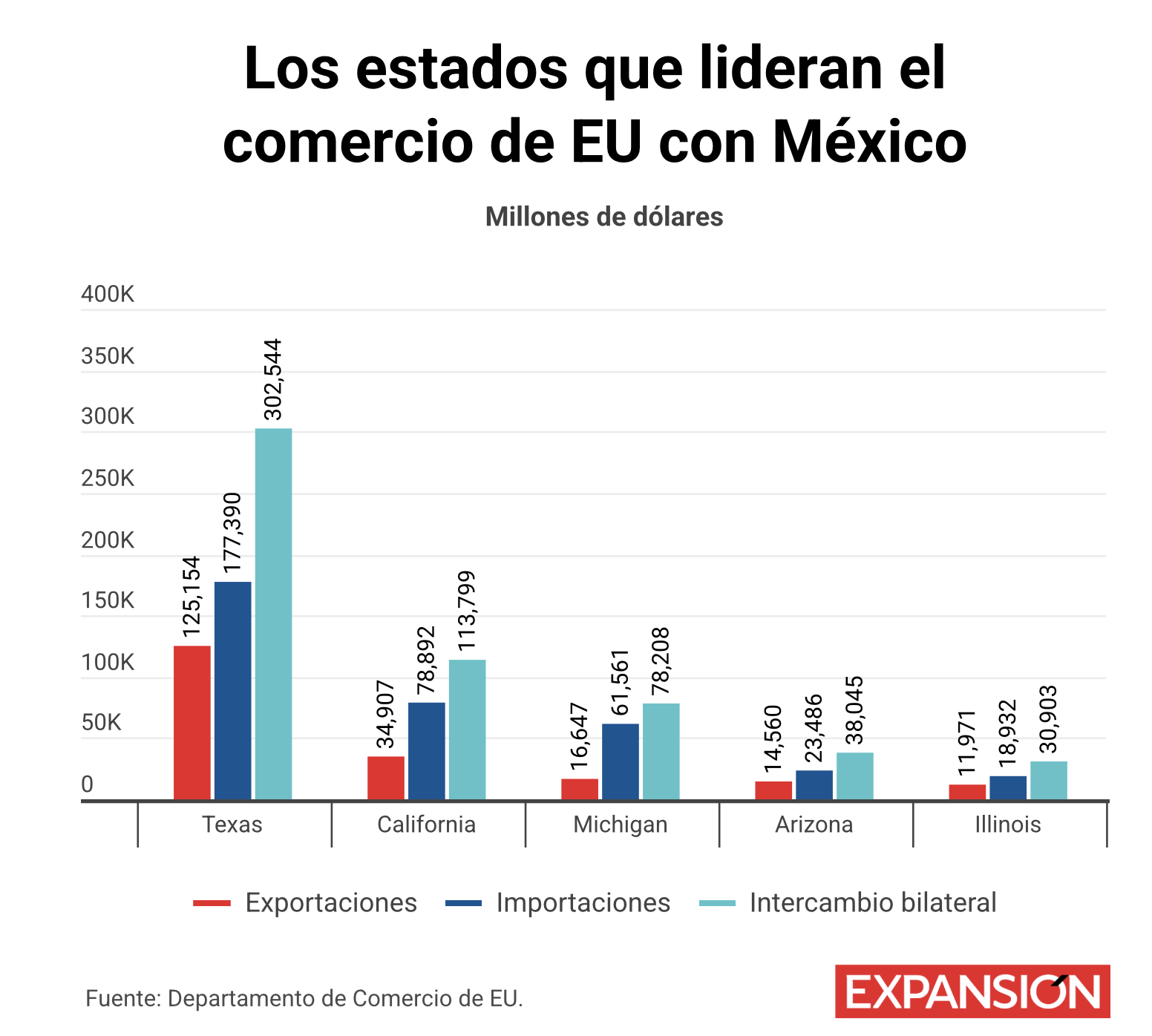
The weight of this relationship also has a very specific geography within the United States. Only five states concentrate close to 65% of bilateral trade, led by Texas, which functions as the main logistical and commercial hub of the relationship.
 Source: Expansión
In advanced manufacturing, Mexico also gained ground in a segment that ten years ago would have seemed improbable. In 2025, it surpassed China as the main supplier of advanced technology products to the United States, a group of goods sensitive to US economic and national security. Exports of computer equipment showed particular dynamism, driven by the expansion of the technology sector in the United States.
The trade deficit that Washington maintains with Mexico also grew in relative terms. It is already equivalent to the one the United States registers with Thailand, Japan, and India combined, and is approaching the size of the deficit it maintains with China.
The advance occurs in an environment not without pressure. The automotive sector, whose supply chains cross the border several times before a vehicle reaches the final consumer, registered a contraction in external sales of vehicles and auto parts during the last year, a partial effect of tariff increases. The preferential treatment offered by the USMCA for products that meet its rules of origin has allowed much of Mexican exports to remain competitive, although uncertainty about the formal renewal of the treaty remains a variable that the market closely monitors.
Bilateral agri-food trade exceeded 74 billion dollars. US agricultural exports to Mexico grew by about 1%, while US purchases of Mexican agricultural products fell by about 10%, in a context of adjustments in demand and international prices.
For the next+ team, the magnitude of these numbers demands a reading that goes beyond the record. An exchange of 872.834 billion dollars is not just a trade balance figure, it is evidence that Mexico and the United States have built one of the most integrated productive chains in the world in just three decades. This integration is also the main source of vulnerability: any disturbance in US trade policy, a tariff increase, a renegotiation of the USMCA, or pressure on rules of origin, is immediately transmitted to sectors that employ millions of people in Mexico. For companies operating in binational value chains, the strategic reading of the moment is not to celebrate the record but to understand that the strength of that relationship and its fragility are exactly the same thing.