

In 2025, Mexico was the largest exporter of electric vehicles to the United States, surpassing Germany, Japan, South Korea, and Canada, with a record of $8.336 billion, completing six consecutive years of year-on-year growth. Three months later, the landscape changed dramatically: Mexican exports of electric cars to the U.S. market fell 69.6% in the first quarter of 2026, plummeting to just $700 million, according to data from the U.S. Department of Commerce.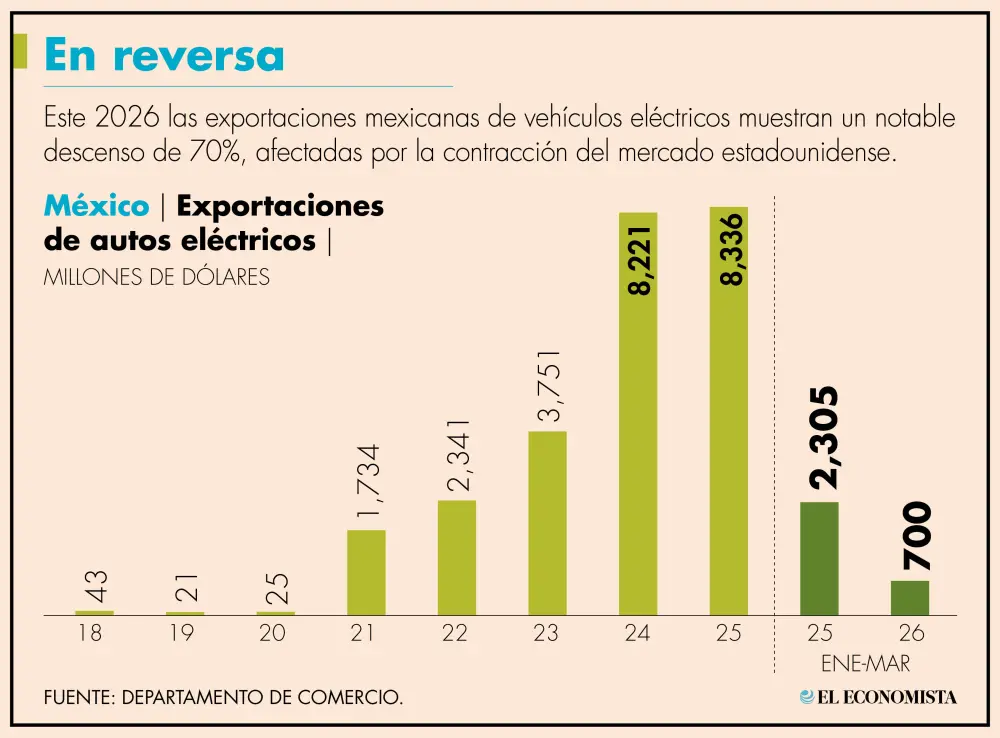 Source: U.S. Department of Commerce, via El Economista.
The collapse was not uniform among the models assembled in Mexico. Of the six 100% electric light vehicles produced and exported from the country, five recorded significant declines during the period. The most extreme case was the Jeep Wagoneer: in the first quarter of 2025, it exported 7,749 units; in the same period of 2026, it recorded no shipments. The Blazer EV fell 76.9%, ending with 1,565 units. The Chevrolet Equinox EV declined 70.3%, with 4,692 units exported. The Honda Prologue dropped 57.2%, to 4,136 units. The Ford Mustang Mach-E registered the most moderate decline in the group, with a reduction of 38.2% to close at 7,765 units. The only model that did not decline was the Cadillac Optiq, with 3,461 units and a marginal increase of 1.3%.
The debate over the causes of the collapse has two narratives that do not quite match. The Secretary of Economy, Marcelo Ebrard, attributed the decline mainly to the elimination of tax incentives for the purchase of electric vehicles in the United States, a policy of the Trump administration that reduced demand from American consumers regardless of the vehicle's origin. "The most significant impact we had is because the incentive for the industry, for electric vehicles, disappeared, and not because of the impact of Section 232 as such," the secretary noted. The Mexican Automotive Industry Association has a different view: in a letter addressed to the U.S. Trade Representative last April, its executive president Rogelio Garza explicitly acknowledged that the Section 232 tariffs have harmed the industry and requested their exclusion, arguing that their implementation has already damaged regional competitiveness.
The impact extends beyond electric vehicles. Total automotive exports from Mexico to the United States, including auto parts, trucks, and cars of all kinds, recorded a year-on-year decline of 11.3% in the first quarter of 2026, closing at $38.051 billion. This figure adds to the contraction of 7.2% recorded throughout 2025.
The technological context and industrial policy are relevant to understand the magnitude of the change. Between 2010 and 2024, electric vehicles grew from 2.4% to 20% of the share in U.S. national sales, driven by federal emission regulations and tax incentives. This growth was the engine that turned Mexico into the main supplier of electric vehicles for that market. With the reversal of that incentive policy, demand contracted, along with production and exports from Mexican plants.
From the perspective of next+, this episode illustrates a structural vulnerability that goes beyond the automotive sector: when the demand for a technological product critically depends on government subsidies in the target market, the entire supply chain becomes exposed to policy decisions that occur outside its control. Mexico built a leadership position in electric vehicle exports in six years, and that position evaporated in a single quarter. For technology and advanced manufacturing industries that operate under similar schemes of dependence on external incentives, the strategic question this case raises is how much market and demand diversification exists as a buffer when conditions change.