
Historically, global-scale sporting events have been managed under a linear marketing premise: greater audience equals greater return on investment. However, the 2026 World Cup scenario is proving that this logic is now insufficient. In an era defined by message saturation and a deep erosion of institutional trust, the Mexican consumer is not just watching the game; they are auditing the brands involved.
The transformation we are experiencing is relational. The 2026 World Cup has become the largest laboratory in the world for understanding the new attention economy. Data shows us that the enthusiasm for hosting coexists with sharp skepticism about brand transparency and the effectiveness of traditional channels. For teams and strategy leaders, the challenge is already about buying legitimacy.
The Crisis of Influence: The Collapse of "Paid Content"
One of the most disruptive findings today is the fall from grace of influencers. 52% of Mexican consumers claim not to trust influencers participating in advertising campaigns for the World Cup. The reason lies in the perception that their opinion is "bought" and lacks authenticity.
Meanwhile, credibility has shifted toward experts and passionate individuals. Professional sports analysts and commentators maintain trust levels of 69% and 67% respectively. Consumers have learned to distinguish between those seeking the "click" and those possessing moral authority on the subject.
What does this mean for a brand?
Brands must partner with voices that consumers perceive as passionate, not just as distribution channels. Investment should prioritize relevance over reach.
What changes for content and social media?
Content must be much more organic and less commercial. 52% of consumers reject campaigns that feel forced. For platforms like TikTok and Instagram, the hook must be humor or deep inspiration, integrating the brand organically into the narrative, not as an interruption.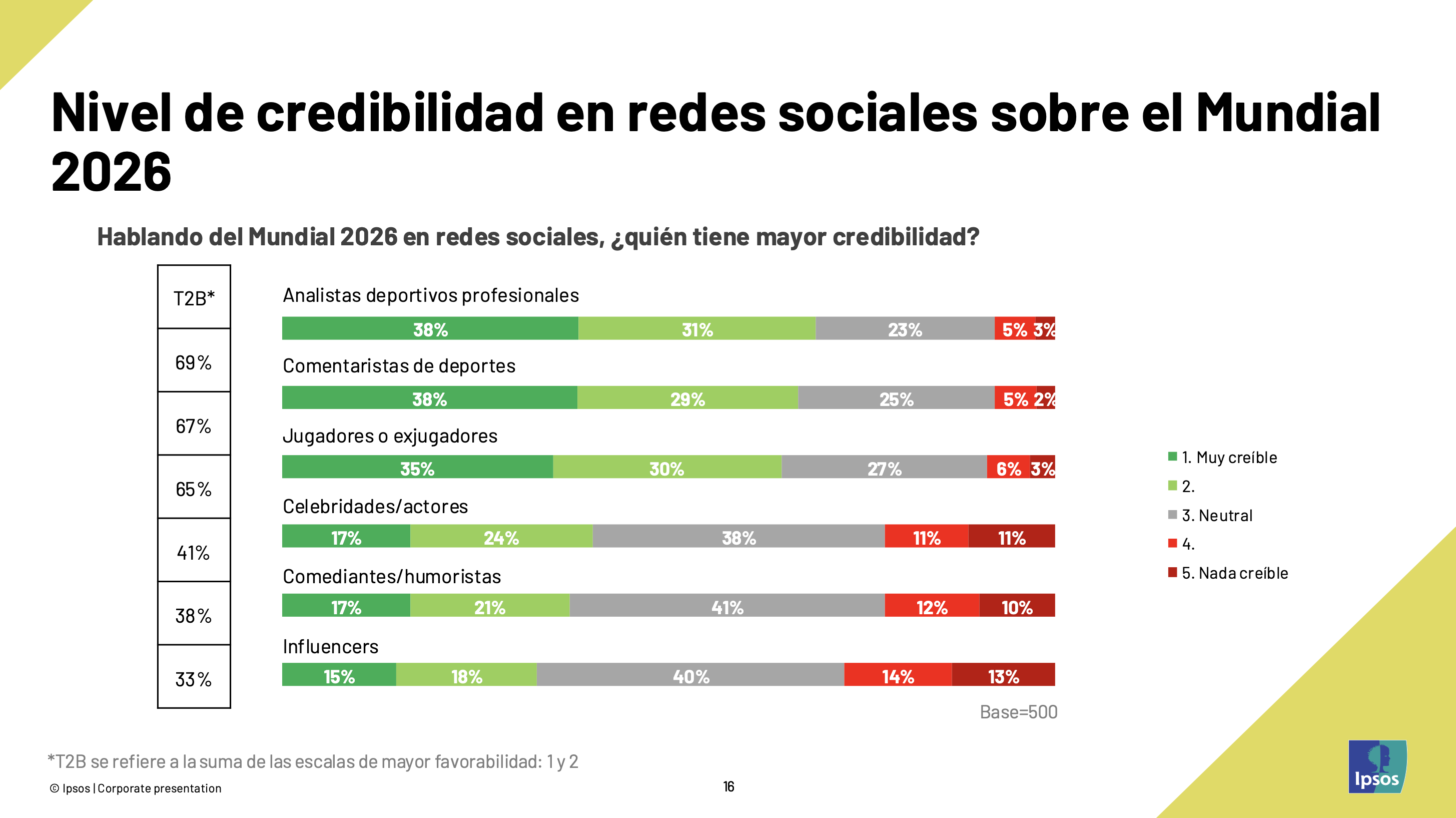
Image: Credibility level on social media regarding the 2026 World Cup (Source: IPSOS Study).
Comparison of consumer trust levels toward different public figures in the context of the 2026 World Cup. There is a massive transfer of trust from digital influencers to expert analysts and figures with technical authority.
The Stadium is at Home: The New Omnichannel Attention
69% of Mexicans planned to watch the matches primarily at home. This data, which may seem trivial, is the cornerstone for Retail Media and E-commerce strategies. The 2026 World Cup takes place in living rooms, in front of multiple screens combining open TV (57%), pay TV (50%), and streaming (39%).
This fragmented behavior has generated an "omnipresence of attention." The consumer no longer just watches the match; they place real-time bets (34% betting intention), comment in forums, and consume digital activations simultaneously. The brand that only appears in the 30-second commercial is losing 70% of the real conversation.
What does this imply for Retail Media and E-commerce?
The conversion opportunity shifts to the domestic consumption point. Retail Media must focus on quick-commerce and delivery solutions that align with match timings. If 69% are at home with their families, promotions for mass consumption products must be ready before the starting whistle blows.
What changes for digital advertising and AdTech?
The synchronization between TV and mobile devices is now mandatory. The use of betting platforms like Caliente MX (known by 67% of bettors) opens a vein of AdTech to integrate advertising guidelines within gaming and forecasting ecosystems, where user attention is at its peak.
The Nostalgia for the Tangible: The Value of What Can Be Touched
In a world dominated by digital assets, the consumer of the 2026 World Cup craves the physical. 52% of respondents remember merchandise promotions (cups, t-shirts, soccer balls) more fondly and 26% recall collectibles like albums and stickers. The "cap-collecting" mechanic, associated with historical brands like Coca-Cola, remains the gold standard of recall.
However, there is a critical barrier: skepticism regarding big prizes. 82% have not participated in dynamics to win tickets to the World Cup because they feel the odds are nonexistent or that the mechanics are misleading. The consumer prefers a small, tangible benefit over a large, unattainable promise.
How does this change promotion planning?
Brands must abandon "one big winner" lotteries to adopt tiered prize structures. Offering multiple smaller value prizes (official merchandise, free products) creates a much higher perception of opportunity than a single trip that no one believes they can access.
What does this mean for content?
Transparency is the new marketing. The consumer demands to see real faces, testimonials, and social proof that prizes exist. The brand that broadcasts its raffles live or publishes authentic stories of local winners will be building the most valuable asset of this decade: conditional trust.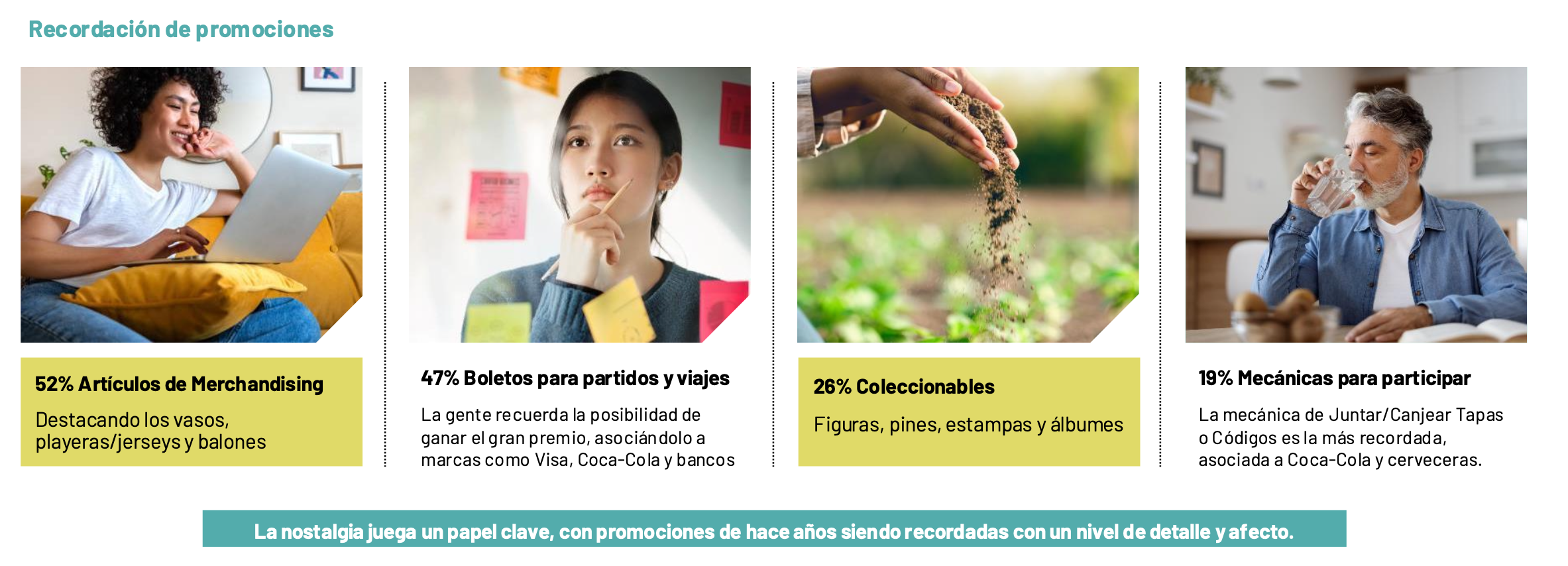
The Hierarchy of Recall: The Tangible vs. The Aspirational (Source: IPSOS Study).
Percentage of recall of different types of World Cup promotions and reasons for non-participation. The consumer values the collectible physical object more than the promise of massive prizes, due to a structural skepticism towards high-value raffles.
The Digital Conversation: Between Pride and Social Audit
The 2026 World Cup has transcended sports to become a political and economic phenomenon. On social media, the conversation is mixed: while enthusiasm for the venue grew (20% positive), there is still a 20% negative sentiment focused on insecurity, corruption, and rising prices (rent, services).
The most used hashtags, like #mundial2026 and #seleccionmexicana, are intertwined with national agenda topics like the "morning address for the people," showing that the consumer views the event through the lens of their daily reality. Brands that ignore these social tensions risk appearing disconnected or, worse yet, indifferent.
What changes for media and public relations?
Brands must act as "Citizen Partners." They need to acknowledge consumer concerns about service saturation and environmental impact. The narrative should balance national pride with a responsible stance towards the local challenges that the event entails.
What does it mean for Influencers and Content Creators?
Creators must transition from "promotion" to "utility." Those who provide logistics guides, safety tips, or information on how to enjoy the World Cup without overspending will have much higher levels of interaction than those who simply pose with the national team's jersey.
Conclusion: Towards a New Ethics of Care
The FIFA World Cup 2026 is revealing to us that the relationship between brands and consumers has entered a phase of skeptical maturity. We are no longer in the era of fascination marketing, but in the era of verification marketing.
The Mexican consumer is willing to connect emotionally with the event, but their "truth filters" are more alert than ever. Trust is granted by the authenticity of the voice that speaks, the transparency of the proposed dynamics, and the value that the brand adds to their home experience.
Companies that truly succeed at the end of this tournament will be those that managed to "accompany" the viewer honestly all the way through. The winner of this World Cup will be defined by the brands' ability to rebuild the bridge of trust that is currently fractured and saturated with the consumer. The question for marketing leaders is not how much reach they are buying, but how much truth they are delivering.
The revolution of trust is no longer a strategic option; it is the only way to survive in the economy of 2026.